BOUNDARIES

BOUNDARIES

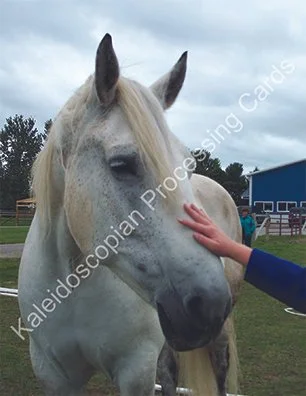
My draft mare and soul horse, Tigger, trained me very well to give her scratches before she left her stall each morning.  To get a sense of her size, I’m 5’5” and can’t see over the middle of her back.  Each time I’d go into her stall, dangling halter in hand, she’d drop her huge head and wait – all 1,800 pounds of huggable, furry, immovable, horse standing solidly asking for me to give her some love. Most days this action brought me pure joy, providing me a moment of being fully present.

Then there were the times when I was running late and “had” to get horses out NOW.  My tardiness did not matter one iota to this gentle giant.  To get her forward movement I would be required to take the time to let her know I loved her – even briefly – before those dinner plate sized feet were going to cross the entrance of her stall.  What a gift she gave me – a required time to pause, even if I didn’t want to or think it was the priority at the time. 

The behavior of stopping to be scratched before leaving her stall was a complete waste of time to my barn manager, Tam.  Tam believed Tigger’s request was the opposite of joyful.   For this life-long horse woman, it was straight-up disrespectful.  She would insist that Tigger move out of her stall when asked.  Tam wasn’t real happy with me either, since I’m the one that created, and actively supported, this bad-mannered behavior!     

Tiggs size is not the predominant factor in her getting her way in our exchange.  It was a combination of her asking and my willingness to respond to her request.  Animals training their humans can take many forms.  Kunigunda is my 8.8 lb. rescue dog who also has me well trained (I’m seeing a pattern here?!).  This little white ball of fluff that looks like a toy instead of real dog, has figured out that when I am on the phone, or a zoom call, if she barks and bats at me with her tiny paws that I will give her treats.  This behavior has been repeatedly rewarded to the point that to be able to participate, without incessant background barking, I have to remove her, shutting the doors to my office!

For those of us in the equine world, getting even the slightest lean (physical shift) into a scary wash rack or horse-eating trailer is a positive result when you are asking a frightened horse to move forward.   One rewards their desired behavior by taking the pressure off, in hopes that the horse will move farther in the desired direction the next time we try.  Horse training is always best when it is on the horse’s timeframe.  Meaning, there’s a core belief with all the horse-people I know that you never end a training session where the horse “wins”.  A horse win could be the equine not moving forward or even backing up further away from your goal.  The human must stay committed to the horse’s learning.  Though if the goal is a full step into the washrack or trailer and time is running out, you’ll take the lean as a win, calling it good. 

You may be wondering why horses would be so frightened of a washrack or horse trailer.  Put yourself in this prey animals’ hooves.  Usually wash stalls are dark, so are the insides of horse trailers.  Both sort of look like the entrance to a cave.  In a horse’s mind there could be a cougar, lion, or other meat-eating animal crouching inside that black space.  Better to avoid it in order stay alive.

What does “lean in” look like in a human context?  Much has been written and researched regarding human decision-making, which usually begins with self-awareness.  The depth of information is vast, from physical considerations like brain research, to mindsets, personality types, learning styles, as well as the effects of various experiences, such as trauma (big T and little t). 

Speed of movement is also something to pay attention to when working with horses.  Managing the optimum speed for the best results.  One solution to a horse moving forward too quickly is to turn them. Let’s say you’re out on a trail ride on your horse.  Beautiful day, slight breeze, puffy white clouds on a bright blue background, chirping birds.  Calmly walking your horse enjoying nature’s bounty.  Along comes one of the world’s scariest creatures.  A squirrel swiftly darts across the path in front of you, startling your noble steed.  Your horse bolts, taking off at a dead run for the safety of the barn. 

You hang on, seeking an open space to be able to turn your horse.  If you’re riding with a bridle, the rider can literally pull a rein (right or left) to make the horse stop going straight.  This redirection pulls them back in their body.  By bending instead of simply running straight, they are forced to pay attention.  Once you have their attention, then the human can work with their horse to reset themselves in order to walk calmly back on the trail. 

One human equivalent to pulling on a rein or re-direction yourself is grounding.  Deep breathing is one way to get grounded, accessing your vagal nerves.  The vagal nerves carry signals between your brain, heart, and digestive system. They’re a key part of your parasympathetic nervous system.  Your parasympathetic nervous system controls “rest and digest” functions. It’s the opposite of your sympathetic nervous system’s “fight or flight” response.

When considering self-awareness, there are many tools, techniques, assessments, and resources to help an individual craft an accurate (at that time) profile of the self.  Tools are devices designed to carry out a function, while techniques are how you use them.  For instance, say you’ve got a lead rope or leash, that’s your tool.  Your success depends on how you use it, that’s the technique. 

Self-awareness is a moving target, evolving as we discover, learn, and grow. If you choose to use feedback from others as a means of increasing your self-awareness, be certain to consider the others’ motives, their role, and incentives.  Feedback is always about the sender, it may or may not be about the receiver.    

Additionally, there are alternative theories, healing modalities, and spiritual practices that humans hold which invite movement or action.  I’m referring to invisible energy fields, the power of prayer, reiki, meditation, etc.  There is increasing science behind how thoughts, emotions, and beliefs have healing power.  There is a fascinating link between consciousness and human connection, as well as the relationship between suppressed emotions and disease.   

Given all of the aforementioned variables, it’s easy to understand why boundary setting can be challenging.  The complexity of setting boundaries, whether for a horse that requests scratches, a puppy that begs for treats, or a friend that takes advantage of you is just that, complex.

Think of the lean-in, horse or human, as a “try”.  With horses, it can be easy to  reward the try.  Give yourself the same grace.  When you lean in, reward your try, then seek to move further into that horse-eating washrack tomorrow.

Recall a time where you set a healthy boundary.  What conditions were present that enabled you to set that boundary?

Is there a current situation where you are feeling taken advantage of?  What do you think you can leverage for the situation to change to be better for you?

What actions are you going to try and who will hold you accountable?


CONFIDENCE

CONFIDENCE

“We Left Our Barn Door Open” postcards with playful artwork telling people to “Hold their Horses” were mailed to Frankenmuth Chamber of Commerce members.  The night before the big reveal, several friends helped with last minute cleaning of floors, setting up tables for displays, creating a welcoming place ready for guests.  Randy helped me position my perfectly cleaned and detailed new dually with a four-horse slant trailer in the arena next to the roundpen.  We placed plywood on the dirt floor deep into the arena near the conference room entrance, creating a stable foundation (pun intended).  We ran power cords, covering them with guards into the space where the band would set up tomorrow afternoon.   

Food was being prepared by a local caterer and artist, Val.  She made custom tabletop signs for each dish with colorful images and descriptions, tucked neatly into horsey-themed bases.  The plan was to have the horses at liberty in the roundpen, offering two short demonstrations of equine-assisted learning.  All the little details were being given careful attention with the goal of providing locals with an remarkable first impression.      

A few things would have to wait until the morning to be completed – the final picking of stalls, sweeping, and any last minute cleaning.  Once we felt we’d done all we could for the night, the seven of us sat around drinking cold beer, swapping stories.  Our laughter stopped when we saw headlights brightly through the front windows.  Car doors slammed as my childhood neighbors, Bob and Sally, along with my Mom and Dad entered the conference room.

I crossed the room to greet them, “What are you doing here tonight?  The Grand Opening is tomorrow evening?”  I curiously inquired.

“We wanted to see your place, so we took a drive.” My Mother replied.

“We were just curious”, my Dad added.  While Bob and Sally nodded their heads in agreement. 

“Well, since you’re here would you like a tour?”  “I’d love to show you the place.” I asked.

Noticing the people behind sitting around the custom-made kidney shaped island, they declined, explaining they just wanted to say congratulations.  They turned to leave, murmuring platitudes about wishing me a successful event.

Once the door shut, I turned to my stunned friends, declaring, “If anyone ever wonders why I am the way I am, you just saw part of the reason why.  Whose parents don’t want to attend one of the biggest events of their daughter's life?”  Then, again, I mused out loud, “not one family members was interested in attending the graduation ceremonies for my Master’s or my Ph.D., so I guess we’re just not commemorative people.”  I sarcastically added.

Deb stood up from the bar, crossed the room, wrapping me a tight, warm hug.  I hugged her back, thanking her for the gesture.  I then turned toward everyone, through tear-filled eyes, I thanked all of them for being “family”.  Little did I realize how significant that statement would be in the very near future. 

The morning of the Open Barn I hurriedly rushed to get chores done, mentally checking things off my list, matching them to the remaining amount of time I had left.  I hoped to attend noon Rotary; planning to make an announcement about the party. I was hoping to encourage business leaders to come out for it on this cold February Thursday. 

After I finished sweeping the aisle, I smoothly backed my shiny new tractor, with manure spreader attached, into the pole barn to get it out of sight of my future guests.  I removed the cotter key from the hitch between the tractor and the spreader.  Because I was rushed and not present, I absent mindlessly grabbed the 20,000 lb. tongue in an attempt to lower it.  It took my right hand with it when it slammed on the concrete floor.  Stunned, I quickly ripped my crushed fingers out from underneath the red metal monster.  Blood gushed, squirting everywhere.  I grabbed an old towel from a ledge in the pole barn, wrapping it around my torn fingers. 

My first thought, as the throbbing started, was wondering how much aspirin related medicine I could safety take.  I called my friend Sara who had once worked for a pharmaceutical company.  I told Sara what happened, inquiring about the pain medicine. 

“How many tylonal and how many advill can I take?”  Not rattled by my question, she told me the amount then asked if I needed help. 

“No”, I told her. “I planned to wrap a plastic bag around my hand, then take a shower.  There was just enough time for me to get dressed, and still get to Rotary on time,” I replied. 

Being right handed, I struggled to figure out how to tie the string around my right wrist so the bag would be waterproof. Unable to secure it, I called my future husband, Randy, asking him to come and help me.  He said he’d be right over. 

He took one look at my bloody and shredded middle and ring fingers, then declared we are going to med express.  I protested.  He was having none of it. 

At our local med express, they unwrapped my hand, then laid it on the x-ray machine.  The tech inappropriately said, “Wow, you really mangled it!”  A few short minutes later, the tech came back into the room, telling us we would need to go to the emergency room in Saginaw.  There was nothing they could do for us here.  The two fingers were broken, the flesh needed to be stitched back together.

Randy drove me to the emergency room 20 minutes away.  We checked me in, then found an uncomfortable bench in the waiting room, surrounded by others in various stages of distress. 

Settling in to the reality that I might not make the grand opening and recognizing that I definitely was not going to be able to complete my finishing touches, I moved into problem-solving mode.  I started calling in the troops – those people who I had confidence would step up and step in to make wonderful things happen.  Each of them told me in their own way that they would “hold down the farm” until I got there.  Trusting my friends would do their best, along with recognizing there was nothing I could do about it, I shuddered a deep, full body sigh then started sobbing on Randy’s shoulder. 

I grieved the loss of what I imagined it would feel like to see all the cars driving in, greeting people, the pride of showing off the months of hard work, decision-making, and stress.  I grieved the potential loss of my fingers.  I cried tears of gratitude for friends who, without hesitation, made this event a priority, confident that they would exceed my expectations. I cried for the love and support I felt from Randy, appreciating his non-judgement and “being thereness” of the moment.

Shortly after I wiped my tears and the snot off my face, I heard my name called.  We were checked into a room by the nurse, told to wait for the doc.  Two white coated men came into the room and introduced themselves.  One was the lead emergency doc, the other a resident in training. 

The emergency doc unwrapped my right hand from the bondage the med express people had put on it.  He poked it with a couple of shots for pain relief, then explained he’d be sewing them up, setting them with a splint.  He also gave me a tetanus shot.  It was a manure spreader accident after all.

He was kind, present, and genuine.  He explained, while cutting a piece of plastic, that he was trying to create something to simulate a fingernail since mine was completely missing on my ring finger.  He told me it was unlikely that the fingernail would grow back normally because of the injury.  He suggested I see a plastic surgeon once the wound healed. 

In case you’re wondering, I have a daily reminder of the accident because of the missing nail.  A really fun hangnail grows every month or so and I haven’t painted my fingers nails in twenty-five years.  Randy jokes I would get a finger-discount on a manicure. 

I shared with the doctor that I was going to be throwing a party in about a half-hour for 200 of my closest friends.  I explained that we had a couple kegs of beer, and that some of that cold brew had my name on it.  I asked him if it be possible to be given pain killers that mixed okay with alcohol? 

He shared that he was a home beer brewer, so he understood.  He gave me two prescriptions.  One beer-friendly for this evening.  The second, stronger for the future.  Small gestures of kindness can mean so much in difficult times!

We drove to the farm, past cars parked all along the driveway and the overflowing the parking lot.  I walked into the conference room filled with smiling, joyful people happy to see I was okay. 

After many, many hugs, pats on the back, and well wishes it was time for our demo.  All the horses were moving comfortably around the roundpen enjoying the attention of the crowd in the arena surrounding them.  I took the microphone, raised my bandaged right hand high, then explained that this was not a horse-related injury.  I told them a rouge manure spreader had attacked me.   Through tears, I shared how incredibly grateful and blessed I was for all the friends and family who helped make this dream come true!       

Can you recall a time when you were confident you could count on others to represent you well?

What were the conditions that gave you that confidence?

What actions can you take in the future to create additional relationships that you can confidently count on?   

APPRECIATION

APPRECIATION

Mickey and Minnie came to Kaleidoscope Learning Circle (KLC) in part because the formula for large animals for Birch Run township meant I could only five large animals on my 12.27 acres.  Technically, Mick and Min did not qualify as a “large” animal when I first got them as young foals.  My philosophy was “it’s better to ask for forgiveness than to ask for permission”.   Because asking meant the township could say “no, I could not have more than five equines”.  I later learned from the township supervisor, when I was preparing to sell my property, that their rule about the number of large animals was just a guideline.  Their attitude was as long as a resident is a “good neighbor” nobody was going to count noses. 

When the two dark furry butterballs arrived from northern Michigan, we released them in the front pasture. There was a small white variegated hut as a shelter for shade or inclement weather.  Then partially filled large black stock tank with fresh, cool water. 

Putting Mickey and Minnie in the front pasture, divided them from the bigger horses by a slated double gate.  This allowed them all to sniff each other safely, bigs on one side, littles on the other, without fear of anyone getting hurt.  Tigger neck was long enough that she could drop her huge white head over the top of the gate.  Mick and Min would lift their noses up to hers, each enjoying sniffs.  The rest of the herd would bend their heads to the side and peak through the slats in the gate to say their hellos.   

The “bigs” (Tigger, Charlie, Al, and Tinkerbell) were in the “shoot” or long pasture running alongside of the property.  They also had access to the back, where there was a run-in for shelter and an automatic waterer.  The shoot and the back were divided by double gates that I painted a bright blue, so we affectionately called it the smurf gate.

Ultimately, we planned to integrate all of the horses one herd.  The range of sizes, colors, and personalities would make for easy metaphors relating to diverse work and family groups.  Observation is a great first activity in a program sequence.  With this range of differences we could create all sorts of engaging questions for EAL participants to ponder.  Such as, who in the herd reminds you of an important person in your life? Or if you had to make up a story about this herd, what would be significant to share about their relationships to each other?

After several weeks of living separately, Sara and I decided it was time to merge them into one herd.  Integrating horses always scares me.  Having grown up as a groom, following orders, I’ve always looked to more experience horse people to guide horse-related decisions. Sara had worked for several different barns, she was very seasoned and experienced in all things horse. 

We started by letting the bigs out into their pastures, a normal day for them.  Then, instead of putting the littles out front, we let them go into the pasture with the bigs.  As expected, there was a lot of running around, bucking, kicking and general chaos.  This is normal, until the herd figures out the new pecking order.  Their behavior determining who is higher up on the hierarchical ladder. 

Tigger, being the lead mare, was moving the least.  Her place in the herd was secure.  Tink, the youngest on lower on the ladder was the most active.  Her bucking and high kicks inspired Al and Charlie to embrace the frenzy.  Their energy, transferred to Mickey and Minnie, who were also embracing the chaos by running willy nilly, feet airborne, their bodies twisted and contorted into arcs. 

Sara and I held our breath, at the ready with halters in hand, waiting for them to settle down.  Then we heard the “kunk”.  Al had accidently kicked Minnie in the head.  She walked away a little dazed, though appeared to be mostly just shaken up.  Sara and I immediately ran towards the herd, deciding that this was not going to work today.  We each wrapped a lead rope around a littles’ neck, then with them in tow, moved the bigs through the smurf gate.  Whew!

We then assessed whether there was a need for a vet call, determining that we could keep an eye on Minn, as it appeared she hadn’t been kunked on her noggin too badly.  Grateful that no one got seriously injured, yet disappointed we’d have to keep them separated.  So much for our plan to have one big happy herd!  We  devised a plan to introduce a couple members of the herd at a time, letting two or three connect rather than one big mixing bowl.  We decided that we’d try that at a later date. 

It was autumn, so we had our annual gig with Saginaw Valley State University (SVSU) for their Youth Leadership Institute.  Roundpen loaded in the trailer the night before, hay bags hung for the horses, and toys for the activity packed, we went into the pasture to grab Charlie and Tigger.  That left Tink and Al in the back pasture, while Mickey and Minnie grazed peacefully in the front pasture.

After a full day of rotating groups of youth from Saginaw county and SVSU student volunteers through an EAL activity designed to help increase their self- awareness, appreciate differing leadership styles, and start building healthy relationships, we returned home.  Sara backed the trailer up behind the barn. 

We jumped out of the truck preparing to back the horses off and let Tigger and Charlie loose with the rest of the bigs.  We looked out into the shoot and saw that not only were Tink and Al grazing there, so were Mickey and Minnie!  We must not have closed the gate between them securely, so they integrated themselves while were gone.  We watched them carefully for several minutes, looking for broken bones, blood, or any sign of distress.  Seeing none, we decided to drop Tigg in first, see how that went, then let Charlie join the gang. 

Sara threw Charlie into his stall, while I walked Tigg into the pasture.  I turned her around, leaving her halter on in case we needed to catch her.  She trotted happily up to the rest of the herd who was near the smurf gate in the back.  When they saw her coming, they all trotted in her direction, meeting in the middle.  Sara and I watched patiently, as they sniffed, sorting themselves out.  No bucks or kicks this time.  The energy was “okay, I guess we all live together now.” 

Now time to let Charlie join the rest.  He was our eldest horse, around the age of 10, and had experienced many barns in his lifetime.  Sara was his previous owner, so she knew him well.  She sold him to me when she bought Tink, which was a great fit for both of us.  We mutually agreed that he was effectively on loan, that someday she would buy him back when she was able. 

Charlie entered the pasture, ears perked facing forward, trotting up the clump of horses in the middle of the pasture.  They greeted him, much the way they welcomed Tigger, with interested sniffs.  Shortly after he joined them, they all decided to go into the back pasture where there was more grass. 

Sara and I could not have anticipated that we had just witnessed the very beginning of many, many years of magical interactions between this perfect herd of horses and humans seeking increased self-awareness.  The diversity of size, personality, age, breed, and gender of these animals was truly unimaginably divine.  As was the divine intervention of them mixing themselves together!   


Have you ever had a “happy accident” happen that greatly impacted your life?

Is there a situation right now that you wish could change, and can’t see a way for it to be different?  What is one action you can take to make this situation better?

When you take that action, how will you know that it has made a positive difference?  What is your evidence?       

CLARITY OF SIGHT

CLARITY OF SIGHT

While working at a local credit union as their marketing director, my good friend, Lynne, learned that she had Multiple Sclerosis (MS).  Lynne quickly began volunteering for the MS Society, sucking in many of her friends to help.  As part of the local MS chapter we were connected to the State organization and its Executive Director, Tammy.  Tammy introduced us to one of her passion projects, Special Days Camps. 

Special Days offer camping experiences for teens with cancer and their siblings.  Through Tammy I learned about a summer camp near me that included access to horses.  Hello!  They said yes to including Equine-Assisted Learning as part of their week-long programming. 

As a parent, one of my fears was that someday I could be one of those people who faced caring for a child with cancer.  Feeling blessed that I could contribute, in a small way, to the lives of these courageous kids; I donated my time, only charging them for the out-of-pocket expenses and the time of my co-facilitators.  I billed a rate of $1,300 for the two days.  Then, I donated $700 back to Special Days where they had a matching program and were able to double the money to $1,400!

Stacie and I met with the riding stable wrangler, Jen, to create a three-hour program focusing on their theme of the day “Insight”.  This was day five of a seven day camp:

Day 1 – Teamwork; Day 2-  Stereotypes; Day 3- Service; Day 4 – Communication; Day 5 – Insight; Day 6 – Leadership; Day 7 – Community.


Special days creates memories and long-lasting friendships by focusing on the kids, not their illnesses.  Both campers (be it the kid with cancer or their siblings) and their families benefit from experiencing the normalcy of camp.  Anyone who has ever been part of a group camping experience, be it band, church, or a Y camp, recalls being responsible for meal clean-up and other chores, a shower block with private showers, and sharing meals together.  Most former campers also fondly remember embracing nature, songs, campfires, and usually some silly traditions, rituals, and games.       


On our day with horses, we spent the morning with opening activities of catch and halter, extended appendages, and then we moved into an activity called Black Box.  Black Box sets people up by creating opportunities for participants to gain personal insight into their choices and assumptions.  The horses offer insight through their responses, adding a layer of complexity by reading the energy of the participants, then reacting.


This is an activity where we divided the group of 20 participants into clumps of five people.  Within each group, we individually took people aside assigning them different – and sometimes opposing – goals.  The goals included halter, brush, saddle pad, lift front foot, and lead to the opposite corner of the arena.  The additional instructions included, not talking without a consequence and no leaving the community.


We invited the participants to decide the consequence if they talked.  It had to be done here and now, as well as multiple times.  The teens decided push ups in poop was the winner.  They shared that they had already coordinated a “group poop” at the camp, so this choice made perfect sense – to them.  Stacie, Jen, and I all laughed, each of us having experienced camping as kids.  Ah, the joy and simplicity of finding body fluids and their functions funny!


The three of us facilitators then surveyed the area to make sure there was enough road apple piles to accommodate our participants.  Seeing there was plenty of piles and trusting our horse partners to add to the poop mind-field, we agreed and asked the kids, “how many pushups”?  The participants discussed it, arguing over the quantity, agreeing with 20 thumbs up on three.  They also decided “girl pushups”, those that are on your knees, were allowed. 


With the consequences agreed to, we asked the kids to count off one through five to randomize them.  Once the groups were established, I explained they would have 10 minutes to complete the tasks they had been assigned. Let the chaos begin!  In each group, one camper grabbed a halter, another a brush, a third hauled the saddle pad off the fence, while the fourth headed toward the horses and the fifth took a lead rope and halter from Jen.


Five “light”, or quarter horse type horses, stood patiently waiting in the large open corral.  These horses were familiar with being tacked up to be taken on trail rides.  They seemed content, just standing there, waiting without saddles or other equipment.  Three of the horses had their ears up facing our group, curious as to what we were going to ask of them.  The other two were more relaxed, dozing with eyes partially or fully closed, one hind leg cocked making a droopy posture to one side.   The two that were half asleep perked up when the kids started gathering their supplies.  They, too, joined the other three horses, ears up facing the group, trying to figure out what was next.


Each group of five people struggled to complete their competing tasks.  For example, as the person assigned to halter the horse was trying to put the halter on, the camper that was tasked to brush started brushing.  The horses were SO confused by the break in their routine!  Some simply walked away from the kids, unless the halter-person had the ability to keep them in place. 


One group followed behind their horse, trying to get the halter on when the saddle pad, which had been tossed on to the horses back, slipped off, making the horse jump a little, then he slowly trotted away.


The third group looked similar to the first, with a horse haltered, a person brushing, and a third person trying to figure out how to lift a front hoof without much success. 


In group four, three people were standing watching, apparently waiting for their turn to do their assignment, not interfering with the two people who did their tasks first.  The person who haltered the horse was holding it, while a second camper was trying to take the lead from the first person, seeking to move them all to the other side of the corral.


Lastly, in group five, the campers were trying to use their fingers as pencils to write notes to each other in the sand.  They were also miming their tasks, working to help each other understand what their individual assignments were.  They seemed to be trying to plan what order they should proceed, by pointing at each other, either shaking their heads “yes” or “no” until they found agreement. 


All of the people were all trying to complete their tasks at the same time, with few of them making any connections to the horses.   Each of the horses responded to the energy of each of their groups’ activities.  Because these were trail riding horses, they were what is considered “bomb proof”.  Meaning, even under chaotic or unfamiliar circumstances, we could rely on them being safe, unlikely to kick out or run someone over.  That being said, Jen watched closely to make sure each of her horses was behaving as she expected, simply moving away from pressure, responding to clear direction, and appreciating the attention when given with respect.        


After about four minutes of this chaotic action, we heard someone talk.  We shouted out to all the participants that they would now have the consequence they chose.  We invited them to detach the lead ropes from their horses’ halters, so that the horses would not step on the rope, hurting or scaring themselves.  Campers looked around anxiously, trying to find dried out piles, rather than getting stuck doing pushups over with fresh, steaming, aromatic ones.  They all eventually got down on the ground, completing their three pushups consequence. 


Then, they resumed the activity for the remaining amount of time.  The consequence broke them from just focusing on their tasks, serving as a sort of reset.  When the groups reconnected with their horses, they all worked together in more unison, having recognized that each group had been set up the same and at cross purposes.     


Following the activity we invited the participants to share with us what they learned.  Their feedback ranged from one extreme – frustrating – to the other – fun.  My guess is their response depended on the task they had been assigned and if they were able to accomplish it.  Through our debriefing, we created space for each person to share their personal insights and how they could transfer that learning back to their lives. 


Our non-judgmental equine partners and activities reminded the campers that they had agency and choice.  That by altering perspectives, we can create space to enter into relationships in a different way with others, with ourselves, and with our circumstances, even if that circumstance is cancer.


Recall a time when you were in a situation that was designed to connect you with others.  Who were the people you considered or chose as your companions?  Why?

 Do you intentionally seek out people mostly like you or those that are distinctly different as you companions?

 In the future are there companions, human or otherwise, you would like to connect to?  What actions will you take to make this happen?     


UNINTENDED CONSEQUENCES

UNINTENDED CONSEQUENCES

Living together in a Y-camp ranch home meant sharing space, forcing experiential learning in real-time.  Bunk beds, a limited number of bathrooms, and one large kitchen created an atmosphere that at times was familial – both loving and tense.

This was session one of a four-part, in-person five-day intensive.  This inaugural event combined the participants in the Equine-assisted learning Masters, the mental health professionals earning a Master’s degree with an emphasis on equine-assisted services, and the post-masters participants in both learning and mental health. 

A collection of people from across the US, including two people from Canada, and a person from Puerto Rico.  Each was drawn to participate in this unique learner-centered, experientially imbedded program because of their desire to incorporate equine partners into their practice or business.    

One of the pluses was having a caterer prepare our meals.  On that first morning together, Joann, the chef, and her helped Marie, provided us with a pile of waffles dripping with butter, bacon and sausage from local butchers, a bouquet of brightly colored fresh fruit, and a variety of toasts made from homemade breads.   

After our bellies were full, we gathered on random chairs and couches in the living area facing the huge stone fireplace.  Paul welcomed all the students to our session focusing on facilitation.  He used a flip chart and colored markers to review the pre-reads that included the theories behind sequencing activities, Kolb’s experiential learning cycle, and the effective use of metaphor.  

Following Paul’s session, Laura, a mental health professional and me, a educator, helped the participants unpack the distinctions between equine-assisted mental health and equine-assisted learning.  We emphasized the importance of staying within your scope of practice by offering a pencil and paper activity that supported the students in identifying their potential/actual clients, working through various scenarios.  

Once we completed the theoretical framework activities it was time to practice what we learned through partnering with horses.  The group of fourteen women and two men walked from the Chauncey Bunk house in the hot Arizona sun to the pasture.  Crossing the dry wash, our cowboys boots kicked up some dust.  We kept our eyes out for rattle snakes and other wildlife known to roam the area.  We reached the barbwire fenced in pasture where 30 or so horses peacefully grazed. 

The horses were a virtual kaleidoscope of colors.  There were several paint horses with unique markings, patches of white on their rears and sides.  Horses with socks and no socks on their legs, others with snips, stars, and blazes on their faces.  Some were solid black and a few where white or flea-flicked.   All gathered in a line on the fence admiring the herd; Paul extended the invitation for our first equine activity.

“We’re going to silently observe the herd’s interactions for the next 10 minutes.  Use your journal to capture the subtleties of their behavior.  For example, who moved who?  Did that interaction affect other members of the herd?  If so, how?  I encourage you to notice what you notice – why does that matter and what is significant?” he concluded. 

After 10 minutes, Paul circled us up to explore our reflections.  Then, he invited us all to enter the pasture.  One by one we walked through the open gate, gently moving horses aside that were trying to sneak out.  The instructions this time were to meet and greet the horses, however we saw fit.  Again, paying attention to our own choices, behaviors, and thoughts.  Did the horse move away or come toward you, ears up, eyes bright with curiosity?  He encouraged us to capture in writing the actions we found curious and explore what might lie behind that curiosity. 

Following meet and greet’s debrief, Paul demonstrated his preferred way to tie the knot on the rope halter’s he had assembled.  Then, Laura invited each of us to grab a halter, find a horse that it fit, halter the horse and then bring them to just outside the labyrinth.  A labyrinth is a physical maze, a complex structure of paths or passages invites reflection, introspection, and self-discovery.  Paul built this one with stone found on the ranch, boarders wide enough for both a horse and a human to navigate. 

Once everyone had a horse haltered and were standing patiently by the labyrinth opening, Paul signaled that whoever wanted to go first should start.  He suggested we enter with a question, leveraging the quiet reflective time while traveling the winding path to seek an answer. 

I was just getting back into horses after many years away from them, so was not very confident in my abilities.  Fortunately, my halter experience had gone smoothly, as the horse I selected, rather the horse that selected me (because he moved toward me when I set out in his direction) was named Nodak.  Nodak, originally from North Dakoda, was willing and friendly. 

Emily, Shannon, Mundo, Jayna, Laura, and Terri were all weaving around the twisting path when I stepped up with Nodak to enter the sacred space.  I paused, took a deep breath, and thought to myself,

“Dear higher power.  Please show me a lesson that will help me serve this program, these students, and the horses as we begin our new, exciting adventure with Prescott College.”

I asked Nodak to move forward, shoulders back, facing forward, confidently holding the leadrope.  He took a few steps then stopped to grab a clump of grass growing between the rocks.  I gently pulled on the lead, his head came up and we continued our journey.  We made it a couple more steps when he found a barely visible tuft of grass, dropped his head to snag the little patch.  Once again, I tugged his head and up it came. 

It was clear everyone was trying to respectfully honor each others’ experience.  Occasional small smiles would be shared as we passed next to each other on the twisted turns.  You could hear the sound of crunching, as horses and humans walked the dry gravel-like path.  The slightly peppery scent of desert sage floated in the soft breeze tickling your nostrils.  Looking toward our desired goal, in the center hung a buddist’s multi-colored flag. The Buddhist flag's six colors symbolize key Buddhist concepts: blue for universal compassion, yellow for the Middle Way, red for the blessings of practice, white for the purity of Dhamma, and orange for wisdom. The sixth, combined band of all colors signifies the universality and unity of the Buddha's teachings.

A few more steps, a couple of turns, and down goes NoDak’s head.  This time when I tugged on the leadrope, he refused to respond.  I struggled, trying harder to get him to move with no success.  Lifelong and experienced horseperson, Laura, happened to be right next to me one path over.  I looked at her and whispered for help.  She suggested I ask him to back-up instead of move forward.  Moving him off the grass in a new way would earn his respect and engage him in what I was asking him to do.

I gently applied pressure putting my hand on his front shoulder with left hand, holding the leadrope in the other, I asked him to back.  Success!  I smiled, mouthed a “Thank You” to Laura and continued on our journey to the center. Now that I had established myself with him as a confident leader, NoDak didn’t try to eat anymore grass.  I became more present, recognizing when he was thinking about dropping his head, anticipating his behavior before it happened. 

Once everyone completed their trip to the center and back out, we thanked our horse partners, releasing them back into the wide open field across from the labyrinth.   Then, we sat on the ground, circled up to share our experience.  I shared how much I appreciated Laura’s help when I got stuck.

Terri said that was a very moving and powerful moment for her.  I asked “why?” looking confused. 

She explained that she was really nervous about being here.  She was older than most of the students here and hadn’t been in school in a long time.  She was a horse trainer who had a bachelor’s in sociology, so thought that maybe getting her masters and becoming a therapist would give her more job security.  She shared that she was also a recovering addict, so felt drawn to help others who may have a similar background. 

She went on to tell us that she thought everyone, especially the faculty, would be better at everything than she would be.  When she saw me ask for help, it reminded her of her own expertise.  She knew more about horses than a faculty member!  She could hardly believe it! 

My eyes welled up with tears of gratitude at her sincere and deeply moving admission.  Her response answered the question I asked entering the labyrinth about a lesson that would serve me.  It was that by being vulnerable, being myself, asking for help was just what someone else needed that day.  I was enough and so what she.    

Have you ever been simply being “you” and later learned that you’ve impacted others in either a positive or negative way? What were the circumstances around the incident that you remember?

Have you taken what you learned from that experience and applied it elsewhere in your life?  If so how?

If there a situation in the future where you can also apply what you learned, what action(s) will you take to facilitate that being more likely?

RESONANCE

RESONANCE

Resonance is critical to the equine-assisted services industry in many ways.  One is when people co-facilitate, working together as single unit to reach the same goals for the client(s).  A simple, and often-used example, is a mental health professional or educator teaming up with an equine specialist. 

I’ve been blessed throughout the years to work along side some incredible co-facilitators where our “dance” together is magically in sync.  We naturally weave in and out throughout our program delivery with ease.  The comfort and confidence we display helps clients witness healthy team relationships.  This is especially true if something doesn’t go as planned.  Then, we are gifted the opportunity to show participants healthy conflict behaviors, staying curious and open, seeking to understand.    

I’ve always cared deeply for the equine-assisted providers, helping them to be the best version of themselves.  I believe all learning begins with self-awareness, so in order to serve their clients best, the facilitators must do their own personal growth work. In addition to joining and actively participating on committees or presenting at conferences or industry organizations; one of the ways I’ve purposefully worked to support equine-assisted services is by collaborating with other providers.

Our field, similar to many others, offers a variety of client-specific trainings.  Each is meant to support individuals enhancing their abilities to help their clients.  The programs range in focus from trauma-informed and other therapeutic offerings to leadership, communication, and healing programs for educators, coaches, and organizational development specialists. 

Two therapist friends of mine, Trudy and Sharon, offered a training they created for kids and horses.  This program used animal handling methods to monitor and report success to funders with outcome-based evaluations.  Income streams are often a challenge for non-profits, which is one reason they designed and developed a way to measure outcomes. 

I invited Trudy and Sharon to bring their program to Michigan.  We worked out all the logistics from who was responsible for what financially and organizationally to where they would eat, sleep, and bathe after they flew in from Wisconsin.  We confirmed what horses they would partner with and other details such as what equipment they needed and whose release forms we would use.  A two-day agenda was agreed upon, post card invitations printed and mailed.  Our efforts resulted in eleven women participants from around the country. 

One of the participants was Amber, a good friend and someone I have co-facilitated with regularly.  Stacie, another friend and co-facilitator acted as our horse specialist when necessary.  The three of us were really looking forward to hosting this event and learning from Trudy and Sharon.  It would be fun for us to not be responsible for all of the facilitation and to be participants together. 

Everything was running smoothly, with Trudy and Sharon running through their agenda.  Their approach was more didactic than ours, which was appropriate for the training.  A didactic approach to teaching is where the information is presented from the facilitators to the participants.  The classroom style material was blended with experiential equine activities.    

Stacie, Amber, and I noticed a little bit of tension between the two facilitators as the first day went on.  A sideway glance.  Rolled eye.  A shrug followed by a muffled “whatever” when one of them didn’t agree with the other.  None of the other ten participants seemed to notice or pick up on the subtle conflict.  The participants’ passion for new learning clouded their ability to catch the understated disagreements.  I was especially tuned in, because being the only non-therapist, the actual protocol was of little interest to me.

Unbeknownst to our guests these two business partners were struggling with their relationship.  I’d known both of these amazing ladies for a handful of years.  First witnessing their tension when I visited their place as part of a committee to create a third-party certification.  It was clear to me that they were no longer fully committed to continuing their business relationship or that they were having fun working together. 

By the middle of day two, Stacie, Amber, and I were jonesing to share our thoughts with each other.  We sat together for lunch with the pretext that we wanted to review the final details relating to transportation, wrapping up, and closing the event. 

The three of us started talking about how grateful we were for the opportunity to work together. We recognized that over the years, each of us had experienced and/or witnessed other facilitator training teams that clearly did not get along.  We reflected on the importance of working through conflict in a healthy way, modelling what we suggested for our clients.  “Walking the talk” was a core value, something we held in high regard.  Always speaking our truth and sharing our fears was a practice we embraced. 

Amber recalled a time when we were working with a group and at a break I asked her to meet me in the mechanical room.  Of course, she said yes.  We excused ourselves from the group, explaining that we needed a few moments in private.  We tried to make that request for privacy seem normal, nothing out of the ordinary, though it was rare for us. 

We entered the room a large closet next to the restroom.  Surrounded by a water heater, several file cabinets, and a corner where brooms, buckets, and mops hung I began.  I shared with her that I had been triggered by what a participant said in the last activity.  I explained that something about the passive aggressive way she responded to my question reminded me of what my mother, Ada, would sometimes do when she interpreted my question as an attack.  I had felt a physical response, a rush of adrenaline through my body and was pretty sure my face was flushed because it felt hot.

At the time of the exchange, Amber noticed my silence, jumping in to keep things moving after my somewhat awkward pause.  Now she helped me reframe the participants’ comment, so that it no longer held the emotional power it did when she first said it.  Because of Amber’s skilled coaching and my self-awareness, we were able to quickly return to the group, picking up where we left off. 

After reliving that story, the three of us wondered aloud whether Trudy and Sharon were conscious of their conflict or if their “way of being” had become so natural that they didn’t even notice it.  We acquainted it to a troubled marriage, where each fight might be different, though the root cause was the same.   It didn’t appear that our visiting facilitators were trying to drive away destructive communication and conflict patterns, replacing them with healthy, productive ones.  It seemed as if they, and thankfully the participants, were completely unaware.

Stacie, Amber, and I surmised that the other participants didn’t sense any tension because they didn’t recognize the difference between good and excellent facilitation.  The difficulty in the relationship between the facilitators didn’t resonate with the participants, in part, because they didn’t look for it, so it was basically invisible.  Trudy and Sharon created a business, worked together for several years, and shared similar values in regards to their work.  The current “falling out” was masked by their long-standing and deeply- rooted commitment to helping people partner with horses for the greater good.     

Sharon gave us all a ten-minute warning, so the three of us got out the plastic wrap and containers, putting away the remaining pulled pork, baked beans, and corn bread.  Amber moved the remaining cookies and brownies to the table by the coffee, making a fresh pot for our caffeine addicted friends.  Meanwhile, Stacie took the overflowing trash container out to the big receptacle in the barn aisle.

We wrapped up the rest of the program, said our good-byes, hugs all around. Once all the guests left, the five of us sat comfortably around my custom built, blue-colored, kidney-shaped island munching on leftovers to review the evaluations together.  Everyone was pleased with the experience.  The training was called “incredibly helpful”, with comments about the expertise of the facilitators.  In the reviews, the participants shared their appreciation for the facilitators’ real-life stories of partnering with other animals, such as Trudy’s dog Dinger, or Sharon’s chickens.  It warmed my heart to hear the facility, food, and overall appearance of the horses exceeded the participants expectations.

Stacie, Amber, and I did not share our observations about the tensions we witnessed with Trudy and Sharon.  In part, because it did not affect our mutual desired program outcomes.  Also, they also didn’t ask.  The three of us knew the personal drain of facilitating for two days; the emtional tole of being present for each participant, balancing that with all of the other moving parts of delivering a program. All five of us left feeling grateful to share our love of partnering with horses, helping others who will reach even more people in collaboration with these amazing four-legged facilitators.   

Have you ever been triggered by someone’s behavior?  How did you respond?

What did you learn from that experience and how has it served you?

In the future are there decisions you can make to reduce the potential for being triggered?  What are they?