DIALOGUE

DIALOGUE

The equine-assisted industry has always attracted a cast of characters who create “certifications” and trainings.  These range from organizations with memberships to individual practitioners who brand their style and way of facilitating into a package that is sold to hungry equine-loving people. 

My client, Nicole from Detroit Horse Power (DHP) and I decided to attend the annual conference of one of these organizations.  We’ll call it Hooves and Humans Association (H&HA).  It was a perfect opportunity for Nicole and I to spend a couple hours in a car together getting to and from the event, as well as her first immersion into the culture of one of the many equine-assisted training organizations.  During the three-hour ride, we easily bonded over our shared commitment to DHP, its’ mission, and horses in general.  Throwing in a little interesting family member stories cemented our friendship! 

I’d been helping DHP’s founder, David Silver, from his beginning over a decade ago.  He attended a customized training for equine facilitators at my farm before he started leading his first summer camps. For the last few years, I’d been consulting with Nicole and David to support them in creating an equine-assisted leadership program.  We’re targeting individuals and organizations living and working in the Detroit area who are seeking professional development and personal growth opportunities.  Once the 10-million-dollar equestrian center is built in the heart of the city and the youth programs are running smoothly, plans are to launch these leadership offerings.

The vision is to have a “stable” (bad pun intended) of facilitators available.  For example, when a potential client is interested in DHP’s leadership program we will match them with a provider that can deliver the outcomes they seek. This could range from solving ineffective communication, or healthy conflict, to developing high-performance teams. 

The work we are doing now is to build the infrastructure or framework.  This means we are mining the industry for best practices, while seeking solutions that happily marry with the DHP youth programs.  The more educated Nicole can get about the equine-assisted industry, the better she can guide our process of introducing potential equine-assisted learning partners; encouraging them to become co-creators of our offerings.     

Nicole and I arrived at the conference hotel, grabbed our luggage out of the back seat of her Jeep and headed toward the hotel registration desk.  After checking into our rooms, we agreed to meet back in the lobby in 15 minutes, to check into registration together. 

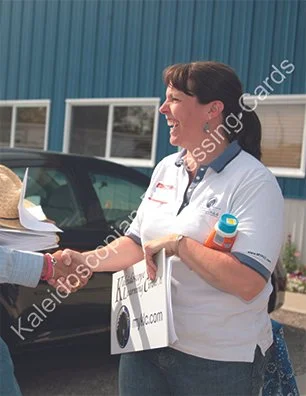
At the agreed time, we be-lined toward the conference registration tables.  Two smiling ladies in cowboy hats and matching turquoise t-shirts featuring a horse logo greeted us.  They checked our names off their computer list and handed us a flyer with a QR code of the conference schedule.  They instructed us to pick up our nametag on the table next them, then decorate it with a variety of ribbons indicating our interests.  They invited us to grab a pop, coffee, and snacks that were at the far end of the room near the exit door.   They completed their introductory spiel by letting us know that the opening plenary session would begin after lunch in the Spartan Conference room just across from the registration tables.  The morning sessions were labeled with signs outside each breakout room. 

Nicole and I thanked them and took our name tags over to the table covered in brightly colored ribbons.  Checking out some of the other attendees, we noticed people with long “tails” of many ribbons layered, stuck together one after and another. 

The light blue ribbon said “Facilitator”.  The pink, blue, and rainbow ones indicated different gender preferences.  There was a yellow one with the letters “DEI Stakeholder” and an orange one with the words “Mental Health” on it.  There were several that we were confused about and didn’t recognize their meaning.  We determined that those ribbons must be for members of H&HA.  Since we were new to the organization, we felt left out and excluded.  Which, ironically, is the core value of this organization – that EVERYONE belongs. 

Lastly, the turquoise one had the letters “EFL” for equine-facilitated learning.  EFL is an interesting choice, since seven industry leaders worked for two years on a terminology paper.   They concluded that for all things equine learning related, aka nontherapy, the services should be labeled equine-assisted learning in education, EAL in organizations, and EAL in Professional Development. 

This white paper was intended for the industry to come together, eliminating the multitude, I mean hundreds, of confusing acronyms.  The hope was that by creating and agreeing to a universal language, research would be more recognized, with potential funding sources realizing that equine-assisted and equine-facilitated could actually be one in the same.     

Nicole and I tried to figure out what ribbons we related too.  I selected EFL (since there was no EAL) and DEI Stakeholder.  Nicole felt she could only represent DEI Stakeholder.  We commented to each other how we felt like we weren’t part of the in-crowd because of our lack of ribbons.  We also noted that for an organization that prides itself on inclusivity, our first introduction was just the opposite.     

We each attended different sessions throughout the rest of the morning, meeting up at lunch to compare notes.  Each of experienced a “sit and git” type session with the presenter in the front of the room sharing a power point.  Death by power point is one of my main complaints about conferences, especially in a field where we practice experiential learning. 

My frustration for it is followed closely by “the sage on the stage”.  I shared my perspectives with Nicole, who appreciates my intolerance, though neither bothers her nearly as much as it does me.  If we’re such experts at creating engaging learning environments, then why oh why don’t these horse people learn to do better and be better.  It’s one thing for “regular” people to not be familiar with connection before content.  It’s another for an industry that literally embraces somatic practices each time they invite a client to their space.  “How can these people be so ignorant or tolerant?”  I ranted to Nicole.

After lunch we sat next to each other in a large hall filled with about 250 attendees.  The presentation took place in the front of the room (of course!) with two presenters zooming in because they had conflicts in their schedules and couldn’t join us live.  The third monitor featuring a presenter was because she had tested positive for Covid just prior to leaving for the event. 

An additional two women sat in chairs on the stage with microphones in hand.  The session was to share the story about the aforementioned terminology white paper.  Each of the presenters, the three zooming in and the one on the stage sat on the two-year committee determined to come to a consensus regarding language. Our host, Margaret, the Executive Director of Hooves and Humans Association was the monitor for the session.

At some point Margaret referred to her work as EFL.  My head quickly swiveled to turn wide-eyed to Nicole, mouthing the gesture of biting my tongue.  Not one person on the panel questioned Margaret’s reference!  Nobody in the room questioned her as to why she had not adopted the new terminology.  This was the opposite of a dialogue.  It was an outrage to me, lacking so much integrity, it took everything in me to stay in my seat.

After the session, Nicole and I stood in the open conference area, reliving what we just witnessed.  I shared with her that I was disappointed that none of the women who devoted so much time and energy to creating a universal language even inquired as to why Margaret preferred EFL.  Sadly, I shared, this is another example of the lack of investment, or healthy risk taking, which was undermining the potential power the industry could collectively deliver. 

I further explained to her that through dialogue we’re able to allow for difference, seeking understanding.  I mused aloud that if they’d have had that conversation in a horse pasture, the horses would have called BS, relocating as far away from these inauthentic people as possible.  As with the equine work, we both left the conference with new unexpected insights by staying open to what emerged right in front of us.

Recall a time when you’ve wanted to challenge someone on a statement they’ve made.  If you did, what were the circumstances that allowed you to move into that space?  If you didn’t, what were the barriers that stopped you?

Have you been challenged by someone on a statement you’ve made?  How did that make you feel?  What did you do about it?

When entering into future conversations, what can you do to invite inquiry and dialogue?  How will you know you’re successful?     
THE END IS THE NEW BEGINNING

THE END IS THE NEW BEGINNING

Drew, my accountant, invited me to provide a training day for him and his staff of six women. One of the best compliments a small business owner can get is to have a stakeholder or supplier hire you for your services.  Equine-Assisted Learning (EAL) puts all of the participants in a very vulnerable spot because of its’ experiential nature.  We’re not a cookie cutter program that is “teaching” a process for more effective communication.  We create opportunities for people to “fail” and learn from those mistakes with our horse partners.  We then help our clients discover and commit to actions that transfer those lessons back to their workplace.  Authentic leaders are willing to put themselves in this exposed environment so that they can learn and grow.  Their new insights offer opportunities to make impactful changes to themselves and their organizations. 

One of our favorite activities for humans and horses is to invite the humans to build a course for the horses to go through.  PVC pipes, colorful pool noodles, orange traffic cones, and other horse-safe stuff.  Drew’s dad, W. Don, who started the firm, was retiring at the end of the year.  The path we invited Drew and his team to make was to represent a future without W. Don at the helm. 

We explained that for the first five minutes they could talk and plan what they were going to do.  After the five minutes, if they talked or touched a horse there would be a consequence.  Sara and I explained that they are the ones to decide the consequence.  The rules were that whatever they decided would have to be done here and now.  It needed to be able to be done multiple times, in case they broke the rules more than once.  Lastly, they were asked if only the offender would be doing the consequence or if the whole group would be.  After a little discussion, they decided that it would be a whole group consequence, reasoning that they were here today for team building and being accountable to all would support them reaching that goal.  The consequence would be jumping jacks.  We asked how many?  Three. 

They spent five minutes of planning reviewing all of the toys.  After the planning phase, they entered the arena with the horses and starting laying out the pvc pipes, cones, hula hoops in two parallel lines.  Even though my horses have seen these same props many times, Chalie curiously sniffed some toys.  Diva moved around the arena, checking out the toys and people, tempting them to engage more with her.  Tigger couldn’t be bothered, she just stood watching the work, patiently waiting to see what would happen next.

The group worked together, using some the pool noodles like an extension of their arms creating pressure which moved the Charle through the path. When he got through to the end all of people turned to look at Sara and I as if to say, “We did it.  Now what” Yet, not one person actually said anything, so we didn’t either.

Not getting the reaction they sought from us, they all kind of shrugged and got back to work trying to get Diva and/or Tigger through the path.  Tigger wasn’t having any of it.  She really doesn’t move unless it’s her idea or she’s enticed through pressure, food, or another incentive such as fear.  D was more willing and responded, like Charlie did, to the noodle pressure;  she moved from one end of the path to the other.  Again the group looked at us, the facilitators, and again, nobody said anything. Once again, we didn’t either.  They shrugged and got back to work.  This repeated itself a few more times. 

Sara and I whispered to each other checking in to make sure we were in agreement that we shouldn’t save them or interrupt their process.  Our instincts were that the learning was happening in the struggle of their being uncomfortable.  They KNEW they had accomplished the goal, yet here they were, repeating the activity over and over because we hadn’t acknowledged it.    

Finally, it was approaching lunch time.  I called Drew and his team into a circle and asked what just happened.  They explained that they completed the task and were waiting for us to tell them they were done.  I inquired, why didn’t they ask us? They said because we told them they couldn’t talk.  No, we explained, they couldn’t talk without a consequence.  Meaning, if they talked and it meant they broke the rule they would have had to do three jumping jacks.  If they talked and we didn’t think that a rule was being broken, no jumping jacks.  In other words, had they asked us if they were done they would have been done with the activity about forty-five minutes ago.

We asked them how the horses responded to the activity.  They noted that Tigger didn’t really move much.  We all laughed.  D and Charlie were willing to go through the path when they used the noodles as wands.  We dug deeper and asked if the horses seemed upset or bothered by repeatedly going through the path.  Mary acknowledged that they seemed more bored than frustrated.  We shared with them that the horse’s behavior, of being calm and present, was an indicator or their organizational culture.  That because they weren’t frustrated or irritated by the repeating of the activity, the horses read that energy and that’s why they were also calm and simply kept doing what they were asked.  We shared that we’ve worked other groups, such as a sales team, that is driven by effective and timely results. Because a sales culture is high energy, we’ve witnessed horses running all over the place to the point of becoming dangerous. 

The big take-away for the group was that their world, as accountants and financial advisors, was to work independently with established deadlines set by the state and federal governments.  Now that Drew would be in charge, he would have to step into that new role.  Over lunch we brainstormed various ways to support Drew in the transition.

A couple of their key lessons learned were that they didn’t clearly define “success” at the outset, so they didn’t know when or if they achieved it.  That they need to think more about the actual “consequences” and evaluate whether takings risks are worth it. They acknowledged that individuals made many, and different assumptions, yet did not take any action to confirm or deny those assumptions.  They also thought if they didn’t get caught, it did not count.  Lastly, they acknowledged they fell into “group think” and subjugated their individual needs (bored, restless, confusion) rather than risk the “consequence”. What they realized was if they weren’t careful and paying attention, that they could be wasting time and resources if they didn’t step back and take a look at the bigger picture.

They came up with seven action plans to transfer the learning. These included having regular staff meetings where they could all come together to share goals and challenges. Each of them established SMART (Specific, Measurable, Achievable, Relevant, and Time-bound) goals, holding each other accountable for reaching them.

Life – not just human life – all life is a series of cycles.   Sometimes endings are clear, planned, and expected.  Other times they are sudden, not recognized at the time as an ending.  In either case they may be welcomed or unwelcomed.  Regardless, an ending is only half of the equation, there is also a new beginning.

Share a time when you welcomed an ending of something even though you were scared or uncertain about a new beginning?

What lessons have you learned from that experience and how does it inform your life decision-making now?

Can you think of a future experience where you can leverage your new found awareness to improve a situation, circumstance, or event?

PLEASURE

PLEASURE

One by one individuals’ cars and trucks flew up the gravel driveway kicking up dust.  We could hear the “beep beep’s,” through the open windows as they locked their doors.  They entered through one of two doors into the conference room.  Stacie and I welcomed them by motioning toward the table piled with baked goods, protein bars, fresh fruit, and string cheese.  We invited them to grab a cup of coffee, tea, or hot chocolate.  The black chalkboard fridge announced in colorful multi-colored chalk the types of cold soft drinks and juices available inside it. 

The group milled around getting acquainted with each other when I announced we’d be starting soon.  An older gentleman approached me asking where he might find a restroom. 

‘First door on the left outside this door”, I stated pointing to the door on my left.  “Be sure to lock it so you don’t get company.”  I quipped.

He smiled as he strode towards the door I indicated.  A few minutes later he reentered the conference room with a puzzled look on his face.   Knowing the cause for his confusion, I looked at him and said,

“Because I can.”

He chuckled and moved toward the butterhorns and apple strudel.

Next, we heard a car door slam and a young lady entered from the parking lot. She approached Stacie and I as we started distributing release forms and pens.  She asked for a restroom as the rest of our guests were topping off their coffee and grabbing a last plate of food. 

When she returned from the restroom, she squared up her shoulders and announced to the group, who were now heads down reading and completing the release forms,

“Why, pray tell, is there a horse head in the shower?”  she inquired.

The gentleman who used the restroom earlier, beat me to the punchline by confidently stated, “because she can.” grinning from ear-to-ear. 

Most people swiveled their heads, puzzled by the exchange, not yet in on the joke. 

The gentleman explained.  I walked into the bathroom and headed toward the toilet on the back wall.  After finishing my business, I turned around to find a brown life-sized horsehead sticking out of the bronze and gold cloth shower curtain. 

I jumped in to further explain. 

“In the hallway on the way to the arena, you’ll find Kaleidohorse, a life-size horse with a multi-colored kaleidoscope design on the barrel side of his body.  We take him with us to exhibits and trade shows.” 

Laughing, I told them “He’s what we call and “easy keeper”.

Soft chuckles could be heard as I continued, “He really draws attention to our booth or display, since he’s usually the only horse in the building.

The horsehead is because when my husband, Randy, suggested I buy this life-size horse.  I originally said, “No” because he was $1,000.   These fiberglass horses are used to display tack, such as saddles or harnesses for western stores or other stores selling horse equipment. At first, I didn’t appreciate Randy’s vision for how Kaleidohorse could be used to tell the Kaleidoscope story, drawing curious people into our space.

One day, I stopped into a tack store in the Thumb of Michigan that was going out of business.  After picking up a variety of half-off helmets, and other bargins, I spotted the horse head. I called my husband, asking him,

“Hey Randy, if a whole horse is $1,000.  What do you think just the head is worth?” 

We both laughed.  A clerk overheard my conversation, then offered,

“Well, this one is for sale for $50 bucks”. 

“Sold” I replied.

Now, what do you do with a horse head that we didn’t need to display a halter or bridle?  Then, like a lightening bolt, it hit me.   

I tucked him in the corner of the half-circle shaped shower, so he’s peeking out of the side.  Realizing when women entered the room they’d sit down and be greeted by him.  More entertaining still, would be the men who most likely would have their backs to him until they turned around. I threatened to add a motion detector sensor so that he could say something clever.  Though I never created a “Mr. Ed” or taking horse, I have had fun when people, like you folks today, get to meet him for the first time.

On a more serious note, part of the reason there is horsehead in the shower is because it being there sets a tone.  It says that we’re here to work and also to have fun.  It’s simple, yet intentional.

Sometimes pleasure comes into your life as a surprise or unintentional.  A unexpected connection that one didn’t anticipate or see coming.  I was fortunate to experience the joy of this accidental? synchronicity when Nicole from Detroit Horse Power invited me to meet with a new barn partner they were considering using for a future program. 

The meeting between Nicole, Deb, and I started with Deb and I connecting over our shared, and different, interactions with the people and approaches in equine-assisted industry.  We discovered that we have similar Meyer’s Briggs personality styles.  She is an ENFP and I’m an ENFJ, meaning we can easily find things in common because we share similar world views and values. 

Nicole was visibly loving our shared experiences.  She told us she wished she could take all our stories and make them her own, learning from our numerous equine interactions.  The back-and-forth between Deb and I was so natural.  For example, I made the comment that my team and I often say “You can’t make this sh*t” up”.  She laughed, sharing that one of her co-facilitators, Betsy, says “Yaka Ma Soo” meaning the same thing!

The most pleasurable part of our interaction was when we moved beyond the boardroom to the pasture.  Once Nicole made her good-byes, warmly giving us both hugs; Deb asked me if I’d like to meet her herd.  I told her I never say no to “petting a pony” so she opened the gate to her five geldings.  The curious boys made their way up from the back of the pasture to check me out.  The bay pinned his ears to ward off the pinto when he tried to enter my space, indicating that he was higher in the herd.  Deb shared the history of each of the horses, while attentively watching to make sure they behaved or at least did not create a dangerous situation.

She then invited me to go through the slated white fence to a pasture where three mares and a gelding were grazing.  Looking at her newly mowed pasture, we randomly talked about the joys of cutting grass.  A simple accomplishment that got us outside, away from a computer, and enjoying nature.  We laughed about how as entrepreneurs and horse owners, the range and variety of “hats” we were required to wear.    

The next thing I knew a gelding purposefully came straight towards me.  I asked Deb what his behavior meant.  She countered with “well, what did it mean to you?”  That’s when I realized I was being facilitated.  It was EXACTLY what I automatically did with people when I had my farm and herd.  I would invite future collaborators, partners, to say “hello’ to the herd with the intent of learning what my horses could tell me about them.  People can tell you one thing - the horses will always they tell you the truth! 

The gelding moved on when one of the mares pushed him away from me, seeking scratches.  I gently began scratching her withers.  I told Deb about how much I was enjoying hearing from past participants while researching my essay project.  That the feedback was so affirming to learn after years had gone by, they still found their equine-assisted experience with me as rewarding and memorable.  Deb then pointed out that the mare was licking and chewing.  A physical sign that I was being congruent with my actions and words.  Affirming my thoughts as true.  WoW, I thought to myself, this is why I Love this work so much. 

Even though I was feeling as though we could easily talk for another three hours, I decided it was time to get home.  We made our way out of the pasture, through the gate. Standing next to my Jeep, we were saying our good-byes when I shared one last story with Deb.  I told her that my daughter and grandson were recently visited and I was disappointed in the minuscule amount of time that I had with him.  Deb looked across the driveway, directing me to witness that her three brood mares had chosen to face me instead of grazing.  She shared she believed their behavior was affirming that my feelings were correct.  Validating that I’d need to have a conversation with my daughter in the future to determine if there was something more going on that I was missing. 

From horse heads in a shower, to being open to new relationships, pleasure is packaged many different ways.  When a person stays open, intentionally seeking connection, the world responds.  And if you’re really fortunate, a horse or two might share their perspective too!

Recall a time when you were pleasantly surprised by an unexpected gesture, gift, or reaction.

Why was your response unanticipated?  What were the circumstances that helped support the surprise reaction?

Going forward, is there an action or behavior you can commit to that will support more positive surprises and results?

PRESENCE

PRESENCE

I met Stacie Johnson through the horse trainer, Robin, at Whispering Pines Farm where I planned to board a new horse.  At 40 years old I was looking for a rideable pleasure horse.  I knew Morgans from my past years showing as a kid, though was open to other similar breeds such a Quarter Horse or Arabian.  Stacie is an Arab girl, specifically, Egyptian Arabians, having bred and raised them for most of her adult life.  So naturally, she found a healthy, middle-aged, Egyptian Arab gelding; a former endurance horse that the owner was looking to sell. 

Stacie and I drove together to the owner’s house excitedly learning more about each other, exploring our shared interest in partnering with horses to help human development.  Stacie is a licensed mental health professional who provides therapy for people through a typical office practice.  She’d worked with a variety of populations, though never heard about equine-assisted services.  She almost couldn’t believe that there was a modality that combined her two passions, helping people AND partnering with horses! 

 I was introduced to equine-assisted learning (EAL) during my Ph.D. program.  The doctorate I earned was based on creating an individual development plan, which allowed participants the opportunity to attend conferences, workshops, etc., then create courses from those experiences.  Because of this learner-centered approach, I attended an equine-assisted retreat and one large conference. Now that I completed my degree it was time to start offering opportunities for other people to experience EAL with me facilitating.  Stacie agreed to be my equine-specialist/co-facilitator in this new endeavor.      

 As I turned into the bumpy dirt driveway, we could see two brown mid-sized horses, grazing in the pasture behind an old two-story farmhouse.  The owner was a typical rural neighborhood horse owner, jeans, boots, cowboy hat and an attitude that implied he knew everything about horses.  He and Stace were acquaintances, which is how she knew about Al. When we arrived at his farm, I didn’t pay much attention to the human exchanges; it was all about the horse for me. 

 I hadn’t been around horses in over ten years and was feeling scared, unsure of myself as a horseperson.  Thankfully, Stacie was encouraging, and I trusted her advice, even though we were just beginning our life-long friendship. We all walked into the back pasture where Al and the other horse, a mare, were loose in the field.  When we approached Al, the mare pinned her ears flat back and began to “run block” putting herself between the humans (the owner, Stacie, and me) and her gelding friend, Al.  I didn’t recognize the mares’ behavior as significant at the time because I was too in my own head about whether or not Al was the horse for me.

 Looking back, I now know that there was an opportunity here to facilitate an EAL experience.  You see, EAL sessions can happen organically, simply by bringing horses and humans together in shared space.  In its’ broadest sense, an EAL experience is when you facilitate or explore, the beliefs, theories, and assumptions between both the horses’ behavior and the humans’ choices. 

 Stacie and I weren’t yet trained in the EAL learning modality.  I’d been exposed to EAL through a couple of conferences.  The journey into all things equine-assisted was just beginning.  In the next twenty-five years, I would go from attending conferences, to presenting at them, to providing training programs, to becoming EAL faculty, to integrating EAL into non-equine college courses, to winning several awards for my work. 

Stacie and the owner responded to the mares’ interfering by haltering her, removing her from our interaction with Al.   The mare being able to push Al around meant he was lower in the hierarchy than she was.  This fact could be relevant if I was adding a new horse to an existing herd.  If you’ve got a herd with a dominant lead mare, one who has a strong sense of their leadership, then there typically is not a problem adding a lower-level herd member.  If your situation includes bullies higher up the ladder, then it’s possible the lower-level herd member will become ill, hurt, or wither because of the rejection.  Horses and humans are similar in our social contracts.  We depend on others in our community, basing our relationships partially on mutual respect, as well as effective and clear communication.

 The owner stood holding the haltered mare, then asked me if I wanted to ride.  Many horse owners love to ride.  Even as a kid, nationally showing Morgans, riding was a means to an end for me, not something I did purely for fun.  I rarely fell off, though never felt as though I achieved a natural “seat”.  I practiced enough over the years from age twelve to seventeen to be a decent rider, winning one contest out of many, the Mid-Atlantic Morgan Horse Show in Pennsylvania.    

Stacie, sensing my fear, offered to ride Al first.  After the owner threw on a western saddle and snaffle bit bridle, he announced that we could “take him for a spin.”  Stacie easily swung her leg up over his back, settled into the seat, and walked him off.  She asked him to trot by squeezing her legs, moving him into a faster gate.  They trotted around the pasture a bit, then came back to where I was standing watching. 

Now it was my turn to ride.  I nervously gathered the reins at his neck, then swung my leg over the saddle.  I relaxed into the saddle, asking him to walk by applying a little pressure with my legs.  Al moved forward slowly.  I took a deep breath, looked around, flooded by memories of the hundreds of hours I spent in a saddle in my youth.  Muscle memory is a funny thing.  My fear diminished as I eased into the rocking sensation of Al’s footsteps on the hard earth.

I pulled back gently on the reins, asking him to stop, adding a “whoa” for good measure.  Al stopped, letting me dismount, boot-clad feet landing firmly on the ground.       

Reflecting on my first introduction to Al, one thing I remember most is looking into Al’s eyes and making a heartfelt connection.  His gaze seemed to be an appeal.  It was as though he was asking me to remove him from his current situation. Between his look and his name, the decision to buy Al was easy. Why was I so enamored with a horse named The Alkkhmist.  Alchemy is “a power or process that changes or transforms something in a mysterious or impressive way”. 

 The mission of Kaleidoscope was/is to partner with equines to help people transform into the best version of themself.  Starting the business with Al seemed as though our collaboration was destiny; a sign that Kaleidoscope had an optimistic future.  Launching a business is scary, especially when you’ve never done it, nor has anyone in your family.  Believing in messages from a higher power has guided me throughout my life, and finding The Alkkhmist sure seemed like a good sign! 

 Al, was, and still is, a companion.  There is a picture of him in every room in my office!  While he is no longer on this earthly plane, his spirit guides me and continues to help me transform.  He was aptly named The Alkkhmist, forever representing an invisible magical force in my life and work.

Have you had an experience where something magical or unexpected happened.  What are your beliefs about being present in that experience?

Do you have practices, habits, or rituals that you embrace to invite more presence?  What are they and how do they make you feel?

Is there something missing in your practice that you’d like to change or invite into future experiences?  What actions are you going to take to create more presence in your life?


PERSONAL POWER

PERSONAL POWER

In 2005 Rochester Institute of Technology (RIT) accepted my proposal to offer an equine-assisted learning (EAL) session for their Pluralism Conference.  RIT is where I earned a master’s degree and was a faculty member for several years.  Our proposal was accepted because we explained that horses respond to a person as they show up in relationship with them.  They frankly don’t care if you have money, status, or a title such as CEO, President, or the biggada boss.  Understanding that difference is our only opportunity for learning (Michael Broom) invites infinite possibilities and curiosity.  We, then, have agency and can offer the same to others, seeking to leverage the positive for mutually beneficial outcomes. 

We, my equine specialist and friend, Sara and I, secured a barn and horses near the RIT main campus.  A group of eight students from RIT’s National Technical Institute for the Deaf, their interpreter, and a RIT faculty member chose to spend the afternoon with us.  We began the EAL experience in our standard way with “meet and greet” experiential activities for both horses and humans.  Creating connection before content is a core value of Kaleidoscope’s programming. 

We were in an indoor horse arena with a large open area where horses were walking, sniffing the ground, and settling into the space together.  The humans are nearby, separated from the horses by a corral.  The humans are invited to enter the horse’s space and greet each one however they feel comfortable.  A greeting can be from a distance, just making eye contact, or close, including friendly scratches for the horses. Not only is the approach decided by each individual, we also do not prescribe anything about the exchanges, such as how long, only one person per horse at a time, etc.   Our lack of specific direction allows us, as facilitators, to witness the choices made by the participants.  Do they pay attention to how their actions impact others’ experiences?  How do the horses respond – do they move away or toward anyone?  What is the energy of the experience – is it heightened and frantic or calm and peaceful?      

The second activity we invited participants to experience was “catch and halter”.  The sequence of meet and greet – just being in a shared space for horses and humans - to asking something of each other, haltering, moves both beings from strangers into building relationships.  One of our jobs as facilitators is to create a place where humans, who may be unfamiliar with hanging out with 1,200-pound hooved animals, get more comfortable.  There’s a sweet spot creating engaged learning environments, which is just outside the comfort zone in the learning edge.  Not everyone’s “edge” is the same, so there is some mastery in managing this space for all the participants. 

For catch and halter, the participants were invited to halter the horses.  A halter is designed to go over the horses’ ears, with the horses’ nose in the center and a snap or tie under the throat.  Again, the participants were not given any specific instructions, nor were they shown the “correct” method of putting on a halter.  We designed this activity to support a learning philosophy of “no right or wrong, just different”.  And the students did not disappoint!  Halters were put on upside down, lead ropes were clipped to the sides of the halter, instead of the bottom; truly many creative alternatives to the standard way of haltering a horse!  Thankfully, our four-legged facilitators stood calmly and allowed for all sorts of learning to safely take place. 

An additional element to the activity is we invited the participants to take part in haltering without talking.  If they talked then they would have a consequence of their choosing.  Because this was the first time we worked with a deaf population, we engaged in an open conversation about what “talking” meant.  It was mutually decided that our rule meant no verbal communication or sign language would be allowed without a consequence.

Nonverbal communication is critical to all animals. While many humans may think they are primarily responding to verbal communication, significant research has shown that we instinctually and unconsciously read and react to nonverbal signals in greater proportion than the spoken word. Horses and other animals are masters at reading subtle changes in body language and other nonverbal cues. For example, a horse’s ears tell you many things about their mood, where their attention is, and in combination with their eyes they can be very expressive and interpretive.  Learning to understand the subtle cues of the equine language requires focus in a way that can help people really “see what they are looking at,” inviting one to stay in the present moment.  

One of the most interesting take-aways from this session was that the individual most challenged by our “no talking rule” was the student’s interpreter.  She shared how she struggled with not being able to fulfill her role as a communicator for the students.  Was this because more of her identity and sense of self was tied to the limitation or rule imposed? 

How often do we inadvertently put ourselves in a similar situation to what the interpreter was feeling?  Meaning, where do we experience limiting beliefs that get in our way of moving forward and threaten our sense of self?  One of the reasons that EAL can be so powerful to human development is because we create a safe place to practice challenges, barriers, and constraints such as imposing a no talking rule.   We then debrief, allowing for reflection and insight into alternative choices.  This opportunity is important because, “We see the world not as it is, rather we see it as we are” (Anaïs Nin).     

Each of us has abilities and disabilities, some visible and most invisible.  These aspects of who we “are” constantly changes, evolves, and informs our actions both consciously and unconsciously.  This is why the adage, that “actions speak louder than words” holds true.  The more self-aware we become the better the chances are that we will make decisions that are congruent with our intentions. 

Where does our personal power have the most impact?  Eistein offers us insight… A human being is a part of the whole that we call the universe, a part limited in time and space. He experiences himself, his thoughts and feelings, as something separated from the rest--a kind of optical illusion of his consciousness. This illusion is a prison for us, restricting us to our personal desires and to affection for only the few people nearest us. Our task must be to free ourselves from this prison by widening our circle of compassion to embrace all living beings and all of nature. ~ Albert Einstein

 Recall a time when the story you told yourself reduced or eliminated your personal power.  What happened? What helped you recognize that you had abdicated your power?

Do you have practices or rituals that help support your in maintaining your power?

Is there a situation you anticipate in the future where you are at risk of allowing your power to be diminished?  What can you do proactively to maintain your power? 

CONGRUENCE

CONGRUENCE

Spread out across the pasture are two miniature horses, one draft, and three “light” horses.  All have their heads down munching on the still-green grass.  The sky overhead is blue with puffy white clouds.  A gentle breeze adds a little chill to this nearly perfect mild fall Michigan afternoon.

Paul was facilitating this activity for the Equine-Assisted Education (EAL) Symposium at my farm.  The three-day gathering brought together EAL providers from around the country who shared a love of partnering with horses in educational settings.  Among the participants were both people new to the field and several who helped create it.  We welcomed Debbie from Indiana who was a founder of programs supporting youth development of life skills.  Also, in the crowd was Ed who worked for a college, offering EAL programs as part of a human resources course.  There were also students in Prescott Colleges Master’s from equine-assisted learning and mental health, from throughout the US and Canada. 

The symposium was divided into chunks, led by some of the most experienced EAL providers in the country.  Paul and Pam were leading the activity that brought us out into this open pasture.  Paul began explaining, in his gentle cowboy way, that he invites the group to divide themselves into pairs, with each pair matching up with one of the horses currently ignoring us.  The goal of the activity is to halter the horse, then let the horse keep doing whatever it wants to.  The humans’ job is to keep the lead rope loose, seeking to match the energy, steps, and cadence of their equine partners.  Paul finished the instructions, then showed the group a pile of halters to choose from. 

One by one participants paired up, finding partners, then selecting a halter.  The halter selection determined the horse the pair was going to work with because of its size.  Mini halter.  Mini horse.  Huge halter.  Huge horse – our draft Tigger.  Mid-size halter – Al, Diva, or Charlie Brown.  With halters in hands, the pairs slowly walked toward their chosen horses, scattered across the three-acre field.   

Charlie decided he’d rather not be haltered because that usually represents work, so he slowly trotted a few steps, then stopped dropped his head and returned to munching on the grass.  The pair of determined participants approached him.  He sensed the pressure of the people, trotted a few more steps, putting distance between the halter and himself.  The pair decided to take a new approach.  One person, without the halter, arcs around to the front of Mr. Brown and began scratching the side of his neck.  Distracted by this friendly gesture, the second person was able to slowly saddle up next to him, slipping the lead rope over his neck.  Knowing he’s caught, he sighed deeply in resignation.  The participant removed the lead rope from his neck, gently putting his nose through the halter opening, flipping the strap behind his ears, snapping the clip shut.

Looking out across the pasture, a sea of pairs of humans with their horse partners.  Most are standing next to their haltered horse waiting for the horse to move.  Others appear to be concentrating on matching their movement, step by step with their horse, seeking to coordinate their speed, tempo, and pace to match their horse’s movement.  To mirror the movements, the humans must be fully present with their horse, ignoring their human partner as well as the rest of their surroundings.  Some are concentrating so hard, one might consider them in a flow state.

People experiencing a flow state have intense focus; their attention is completely directed towards the task at hand, with minimal distractions. They also lose their self-consciousness, no longer worrying about failure or what others might think, wholly absorbed in the activity. Time seems to pass quickly, with the activity itself intrinsically rewarding, rather than seeking external validation or goals. Lastly, there is a feeling of effortlessness. The activity feels unforced and natural, even if it's challenging.  Flow state, also known as "being in the zone," is a mental state where a person is fully immersed in an activity, with intense focus and enjoyment. 

After 30 minutes or so, Paul and Pam shout out for the group to huddle up in a circle to share what they’ve experienced.  Each pair removes the halter from their horses, who all wander away slowly, continuing to graze. 

Pam begins by asking the group, “What struck you?”

Morrigan speaks up first, “being in sync, anticipating what Mickey was going to do next was harder than I expected.  As a lifelong horse owner and rider, I expected to easily match up with him.  Instead, I found myself trying to catch up, not really matching his movements step for step”. 

Pam then asked her, “what do you image made the task so difficult?”

Morrigan replied, “I’m guessing it’s because of my expertise got in the way of my being able to stay present and curious.  Wow, I wonder where else I’m just looking for what I expect to happen, not open to other possibilities?”

Next Jayna jumped into the conversation.  “Mo, I remember a time during one of our Prescott intensives at Chauncey Ranch where a similar experience happened to me.  The assignment was to pick up all four hooves, one at a time.  Now, I’ve picked up horse feet 1,000 times or more she laughed.  So, when I moved into position with my back towards the horse’s head, bent over, and ran my hand down the mares’ leg, gently asking the horse to lift its’ foot I fully expected that she would respond to my cue and lift her leg.  This time nothing happened.  Her hoof stayed firmly planted on the ground, glued to the dirt.  Laura was facilitating the activity, she suggested I re-group by taking a deep breath, get present and try again.  I followed her advice.  The second try the horse understood my ask, easily lifted its’ hoof as if pulled up by a rope.

“Thank You Morrigan and Jayna for your willingness to be vulnerable with this group, sharing those examples.”  Stated Pam.

“One way to reflect on this experience is to recognize the difference between “doing” and “being” she continued.  “Sometimes doing is all that is required of us in order to meet the goal and/or achieve success.  Other times, we are being asked to be more fully present.  Laura’s suggestion to Jayna, to take a deep breath, re-centered her, inviting Jayna to be instead of just do.  See what I mean?” she inquired.  

All the participants nodded their heads affirmatively.  Pam then closed the activity by inviting the group to spend our remaining day and a half practicing being in sync with each other.  Giggling, participants organically paired up again matching their steps with each walking back to the barn as if their legs were tied together in an old-fashioned sack race.  Once again, our horse partners extended a simple invitation to be more fully present!                                   

Recall a time when you performed a task poorly because you mismatched your expectation of how simple the task would be?

How have you taken the lessons from that experience and applied them to other situations?

Is there an event or experience in your future where aligning your intentions and actions could have a significant impact? 

What  can you invite into your life to support the results you desire?