
INTENTION2
Sara and I had each taken an online 4MATSystem® behavioral leadership assessment prior to the in-service conference in South Carolina. We discovered that together we represented a whole brain. In other words, Sara’s brain preferences were for quadrants two and three and mine were for quadrants one and four. Sara liked the world of “What” and “How”. She preferred concepts and skills, patterning, organizing, and analyzing, as well as, inquiring exploring, and problem-solving. I, on the other hand, lived in “If” and “Why”. My preference was for adaptations and meaning, integrating and evaluating, as well as focusing and generating skills. Knowing this about ourselves helped us appreciate, understand, respect, and leverage our distinct differences.
We were fortunate to share our in-service experience with Dr. McCarthy. Dr. McCarthy was the creator of the 4MATSystem®, a framework for organizing learning. 4MATSystem® helped learners construct their own meaning, link new information with existing knowledge, and become more actively involved in the learning process. It made perfect sense that the Seventh Day Adventist (SDA) Carolina Teacher’s Conference would feature instructors like Abernathy and myself, both practitioners that embraced an open-ended learning model. We each, in our own way, helped learners increase their self-awareness, then leverage that for their benefit.
Because I earned my Ph.D. at an SDA college, I was familiar with some of their practices. I shared with Sara that we would likely have all vegetarian meals. Camp food and vegetarian. Now that was going to be fun, we both mused. What I didn’t expect was that there would not be any coffee or other caffeinated beverages available. We discovered this when we arrived at our Y camp cabin. Because we had a rental car, we chose to run to a local grocery store to pick up a small coffee maker and a cooler for our “contraband” non-SDA/vegetarian snacks. Our intention was to get our non-SDA needs met, without disrespecting our hosts.
Our smuggled goods hidden in our cabin, we headed down to the camp’s horse barn. Vern had worked for the camp for several years. Dressed in coveralls wearing a worn, dirty cowboy hat and boots he welcomed Sara and I to his “second home”. Standing nearby, very uninterested in us, were several horses of different sizes, colors, and breeds. Some had backs so swayed that there was an obvious “U” shape, indicating they were older. On many, you could see the sweat mark outline of a western saddle. Several of the horses had white or gray hairs mixed in with their natural color, indicating injuries or traumas, such as pressure from ill-fitting tack, cuts, or injections, that had damaged the hair follicles. None of these observations meant the horses were abused or unloved. They were just typical camp horses.
The teachers, superintendents, and administrative staff of this Seventh Day Adventist school system were all gathered together in the lodge to begin their “Learning from Each Other” Convention. Following dinner, Sara and I would be introduced, to share our plan for them for the next two days. We’d explain to them that all seventy-five of them would be divided into groups of three to four people. Each group will be given the same instructions, though each group would not have the same experience. The experience would be determined by how the people showed up in relationship to each other and our equine partners. We’d be observing how the horses respond to the humans choices, inquiring about the thoughts behind the behaviors. Following the last group, we would all gather in the lodge to share the individual and group experiences, looking for themes, “aha’s, and insights transferrable back to their school environment.
We shared the Classroom Corral’s rules with the first group, quickly learning that SDA teachers are not like public school teachers. They not only are allowed to touch their students, as a Christian school, they are encouraged to give hugs, pats on the back, and hold hands. Many of the teachers were in buildings similar to one-room schoolhouses, with several grades sharing one teacher. We told this first group, and the following twelve groups, that while we respected their day-to-day reality encouraged touch, for the sake of this activity we’d be sticking to our original instructions which did not.
CLASSROOM CORRAL
For the next 45 minutes this corral is your classroom and these horses are your students. Sara and Tracy are the administrators at your school or building. You will have 5 minutes to plan a goal(s) with an essential outcome for your student or students and determine a consequence for breaking the rules (see below). You will then be given 30 minutes to execute your plan. We begin class by ringing the bell and then saying the pledge of allegiance.
Non-Negotiables (rules):
1. No physically touching the students (horses).
2. No using halters or leadropes.
3. No bribing or simulating a bribe.
Freedom:
1. You can use any of the resources in your community (this corral).
Consequences:
Breaking a rule requires a consequence. You may select the consequence, which can be executed by the group or the offending individual or you may elect to accept the individual consequence developed by the administration.
The groups would rotate through with horse partners, Smokey, Leroy, and Jeb. These geldings started out unengaged, disconnected, and very non-present. Camp horses are expected to stay in line on the trail, nose to tail, following the horse in front of them day after day. Basically, to shut down, robotically putting one foot in front of the other. Similar to an employee that is told to check their personal life at the factory or office door; these horses were expected to simply do their jobs.
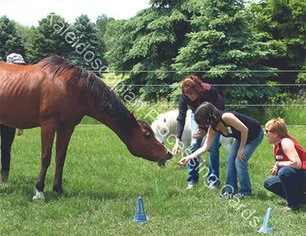
Vern was amazed at the transformation of his horses by the end of day one. The horses figured out that we wanted them to be themselves in the activity, that they were rewarded for showing up and being curious. Eyes brightened. Ears perked up. Each one of our four-legged facilitators was enjoying the experience of working with these humans on the ground, being asked to move through, around and over cones, pvc pipes, and pool noodles. Our intention was to help increase the humans’ self-awareness, and by virtue of our work, we showed Vern a whole new side to horses he thought he knew so well!
One of the highlights of our time at the SDA conference was with the last group. The administration. They entered the horse space engaged and enthusiastic, sharing that they had heard only good things about the experiences from their teachers and staff. They were amazing and delighted by the differences between the group experiences, excited to hear our collective debrief later that day.
As we read them the Classroom Corral rules, we noticed that our horse partners were even more interested in the nametags hanging around the necks of Robert, Renee, Ann, Pamela, and Sherry then at any other time. Smoley, Leroy, and Jeb were not only fully present, they were literally poking their noses into the chests of our participants, lightly nipping at the dangling clear plastic nametags. When we investigated, Sara and I quickly discovered that these leaders had hidden apple pieces and carrot chunks behind the pieces of paper with their name on it.
This was the only group that tried to cheat by bribing the horses. The administrators’ intention was to be the best. To “win”. Since our goals had nothing to do with winning, or even the task, this choice of sneaking in treats for the horses really opened up some great dialogue.
When we debriefed the equine experiences with the whole group, two major themes emerged. One was the unexpected change in the horses’ behavior over the two days. The participants recognized that their groups’ location in the schedule influenced whether the horses were engaged or not. The educators bridged this occurrence with their students, recognizing how outside circumstances influence the way the children show up in their class on any given day.
The second big “aha” was the choice of the administrators to break the no bribing rule. Their decision led to rich discussion about how and when the ends justify the means. Sara and I helped them personally reflect on their own self-awareness, expanding the conversation from their actions to examining the larger system, such as parents, the SDA community, and the educational measurements guiding them. We also bridged the behavior back to Dr. McCarthy’s 4MATSystem® model. The feedback was, “You truly helped us learn from each other at this conference.” Our intention and result matched perfectly!
Recall a time when your results exceeded your intention. What were the conditions present in the situation? Can you remember what your body told you about the experience?
Is there a current situation you can apply what you learned, either my exceeding or falling short of your intentions?
Are there places you can apply what you learned to future experiences? What does that mean in terms of how you are showing up, especially if things do not go as planned?