
AUTONOMY2
A local organization that provided undergraduate, resident, and physician training hired us for a half-day team development. There were 19 participants, so creating an effective design for that many people with such a short amount of time was critical for success. I believe that the closer I can get to the clients’ environment, culture, and experiences, the more easily the learnings are transferrable.
For our first equine activity, we randomly broke them up into three smaller clumps. Having three groups, two of six people and one of seven, allowed them all to make connections, both with each other and the horses.
Because we wanted to set up some communication barriers to challenge the groups to get creative in their problem solving, we included a consequence, of their choosing, if they talked. We also gave each group a unique set of instructions. If a group watched another groups’ engagement with the horses, it could be obvious that they were not all given the same assignment.
All of the instructions included the request, “Please don’t share your instructions with others” and “Remember if you choose to talk there will be a consequence”.
Group One: Please introduce, however you define that, yourself to each of the horses.
Group Two: Your task is to introduce yourself (however you define that) as a group to each of the horses beginning with the largest horse, then the next largest, and so on ending with the smallest until you have met all six KLC horses.
Group Three: Your task as a group is to thoroughly assess the six horses according the following guidelines. Please follow these instructions in detail, as it is critically important that you provide us with the information we require in order to determine whether the four-legged facilitators are in good health and capable of meeting the responsibilities and expectations of the work we will be doing later today.
How you decide to share the workload is entirely up to your group to decide.
Safety is important, yours, your team members, and the horses, so be aware and sensitive to your surroundings and the implications of your actions. Thank you for your effort and focus on this important and extremely valuable process.
1) Verify that each horse is breathing normally
2) Check the horse’s pulse to determine if it is in the normal range and look for signs of distress
3) Determine overall physical appearance of each of the horses. How is their coat, composition, etc.
4) Is their eye-opening response at a reasonable time
5) Using the Vassall Demeanor Scale (attached), rate each horse and record its’ score
The “Vassal Demeanor Scale” was a made-up assessment to test Group 3’s beliefs and assumptions. Because of the complexity, especially in comparison to the instructions given to Group 1 & 2, Group 3 would be challenged to find effective ways to communicate and come to consensus. The Vassal Scale (cleverly named after one of my employees) invited participants to assess all six horses, assigning points to descriptions which fit one of three categories:
Ears: Up (4 pts), Relaxed (3 pts), Back (2 pts), Pinned (1 pt).
Interactions with Others: Aggressive (4 pts), Playful (3 pts), Isolated (2 pts), Victim (1 pt).
Tail: Relaxed (2 pts) Swishing (1pt).
The biggest challenge was that all the actions could be true at different times. As with all our activities, the “how” of their working together and communicating was where our attention would be.
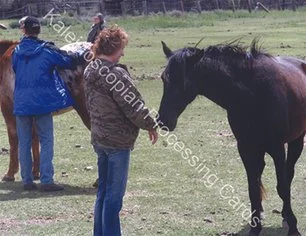
After handing out the instructions, we moved to the side pasture where the horses were at liberty grazing. We called this pasture “The Shoot” because it was long and narrow, the electrobraid ran the length of the side of the barn, along my front and back yard on one side and along a tree-lined, weedy ditch on the other. The horses immediately trotted up to the gate as we started letting the people into the pasture. My team and I worked to let the people safely in, while not letting any of the horses escape into the barn. Once the gate was shut, the groups spanned out. The horses were calm, curious, and interested. Their energy told us that the participants enjoyed being close to our horses, experiencing them as living, breathing, subjects or pseudo-patients.
The participants in Group 3 eagerly engaged in the opportunity to silently debate and decide how many points each horse would earn for each area of the Vassal Demeanor Scale. Each time a horse moved, you could see different members of the group using hand signals or drawing in the dirt to advocate for changing the points they had assigned. Groups 1 and 2 were calmer, moving quietly around the pasture, introducing themselves.
After a half hour, we gathered everyone together to debrief. I started with, “What struck you?” A young, tall, Caucasian male future doctor, Craig, part of Group 3, shared that he thought they all worked well as a team. I asked him what evidence he had that they were a team. He declared that they had come together to agree on the points, so they were definitely working as a team. I gently challenged him, explaining, that yes they did come to agreement, after what appeared to be some debate, yet that did not make them a team. He doubled down on his opinion, telling me that they were indeed a team.
The people that had been a little disengaged in our debriefing conversation perked up, paying attention to our exchange because of Craig’s determined and heated declaration. The horses that had been near our circled group also felt the increased negative energy and slowly started to move away from us. I calmly explain, again, that, yes, they had worked together, yet they were not a team. I shared that high performance teams take time to develop. That the definition of a team included holding each other accountable and collaboratively solving problems to consistently achieve outstanding, sustainable results that exceed expectations.
Our future doctor, tripled down, trying to get the others in his group to take his side, appealing them by asking them, “Hey guys, we were a team, right?” The other members of Group 3 looked uncomfortable, exchanging glances with each other, unsure of where they should stand in the exchange.
That’s when the senior most physician, Dr. Tarigopula Deepthi an older, shorter, rather round, Indian man, stepped in between Craig and me. He looked directly at Craig, and with authority asked him which one of the two of us knew more about teams. Who was the “team expert”? Craig shrugged, admitting that I most likely had more expertise when it came to teams. He then turned, briefly and purposefully making eye contact with everyone, he asked:
“What if this situation had been in an emergency room, instead of in a horse pasture”? He asked.
“What if a more experienced doctor had tried to, calmy and professionally, disagree with Craig and instead of listening, took the position he did with Dr. Weber, and insisted he was right?” He continued.
Dr. Deepthi shared that Craig’s unwillingness to listen and learn could cost someone their life.
After a short break, we moved into our next activity, Storyline. Storyline facilitates personal discovery by inviting participants to create a picture of their lives. The birds-eye view offers them a chance to look back at the design of seemingly disconnected pieces which fit together through their choices, decisions, perceptions, and awarenesses. We asked them to be as visual as possible, without words.
I approached the group sitting around own two picnic tables on the barn’s front concrete area. After reading the instructions, Dr. Deepthi looked up at me with concern. He told me that there was no way he could complete the assignment without using words. I smiled, then invited him to try. He smiled back, grabbed a bright green marker from the center of the table, lowered his head and began drawing.
I moved on to check in on the other two groups. When the hour was up, I approached the picnic table group, finding Dr. Deepthi animatedly sharing his wordless map with his colleagues. I had to cut him off mid-sentence because he was having so much fun sharing his story. He told me that he hadn’t realized how much he would enjoy engaging his right, creative, brain, recognizing that he is predominately always in his left, or thinking brain.
Our last activity was designed to help them relate to what their patients experience when entering a hospital. While the physicians go into the hospital daily, becoming very familiar with the sounds, smells, and cadence of sick people. For their patients, a hospital could be an unfamiliar and scary place.
We invited our participants to each ride one our horses through a small pvc lined maize. We front-loaded the experience with all sorts of safety measures, including side walkers, a “high sign” if they wanted to stop, teaching them the emergency dismount, and assigning one of our staff to be a safety coordinator. We told them that once they reached the back of the maize, we would blindfold them, further enhancing the experience.
Everyone accepted the challenge to ride. Charlie, Al, and Diva each responded respectfully, calmly moving with KLC staff on either side of their bodies, as another was in front leading. The horses walking with a saddled rider on their back were like doctors entering a hospital; they were being asked to do something they were very familiar with and had experienced hundreds of times. Without incident, we were able to provide each participant with an opportunity to put themselves, sort of, in the shoes of their patients by moving them from their comfort zone to the growth/stretch zone.
Recall a time when you had autonomous control to make a decision. What were the conditions that gave you that independence?
Have you experienced additional situations where outside influences threatened your autonomy?
Is there any actions you can take in the future to ensure additional autonomy? If so what?