JOY

JOY

Stacie’s friend, Nancy, was a high-powered executive in equipment sales to veterinarians.  As the top salesperson she travelled the country to meet with doctors serving large, wealthy, farm and ranch owners.  She was also a successful and dedicated horse woman, breeding, showing, and judging horse shows for three decades. 

Nancy had a horse, Buddy, that she was looking to rehome.  She discovered, after numerous tests and thousands of dollars, that Buddy, a former championship gelding, had an unrepairable injury.  His sternum had torn detaching it from his chest wall.  He would never again be able to perform up to his past accomplishments. 

She knew from his former owners that horse trainers had thought his lack of performance was behavioral instead of realizing his chest muscle was completely torn from his breastbone.  Because these people decided it was behavioral, their training methods were often cruel; some might consider it torture or abuse.  Many people in the horse world still consider “breaking” a horse to be a valid and useful method of gaining compliance.  Nancy’s years of experience with horse show people helped her recognize that they would be too tempted to push him beyond his physical limits when they read his pedigree.  Once they saw his winning past, career stats, and blood line, they would likely put their desires to win “at-all-costs” over his physical ability to compete.       

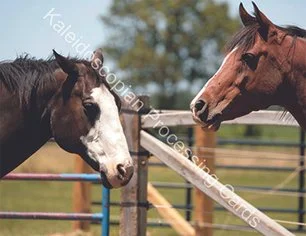
Nancy decided she would find a non-show person who could home him so that he could retire from performing.  She felt his sweet disposition and calm presence would be perfect for someone who could just appreciate him.  I became that someone for three months.  Since I am not a rider, the fact that he wasn’t easy to ride didn’t matter to me.  He came with a few other challenges though.  He had to be pastured alone because the one time he was with another horse, Nancy was afraid he was going to literally kill the mare she had in the pasture with him. 

Once I met him and agreed to re-home him, I reached out to a farm four miles from our home.  My former farm manager, Tam, had worked at Wendy’s for years.  Wendy didn’t normally accept boarders, though when Tam asked her if I could board Buddy, she responded, “I like Tracy” welcoming Buddy and I to her barn family.

I went into the relationship with the intent of building a relationship with Buddy.  Period.  It had been years since I had a regular connection with a horse, so I was looking forward to the opportunity. I created a reflection sheet to capture our exchanges.  In addition to basic facts, I included “my mindset” “desired outcomes” and “actual outcomes”.  I also dedicated a journal to periodic reflections of our interactions. 

His delivery day finally arrived, a day with Spring thunderstorms dancing across the State.  While I patiently waited at Wendy’s for Nancy to arrive with Buddy, I wandered around the pastures, curiously looking down at the grass and clover.  Surprisingly, peaking through the kelly green grass and three-leafed plants was a magical clover with four petals!

My finding was reminiscent another time I discovered this serendipitous omen.  It was the only time I won a horse show championship. When I was a teenager showing Nipper Jon in Pennsylvania I was walking back from our horse trailer, through the huge field, making my way to the barn prior to my class.  It was the first time I would be riding in a championship; the judge having placed Jon and I first in our English pleasure class.  I found a bright shamrock green four-leaf clover poking its perfect shaped leaves steadily toward the sun.  I now had a dilemma.  Which would bring me more luck – feeding the yummy morsal to my beautiful flaxen gelding or tucking it in my pocket?  I chose to feed it to Nipper, whose soft cleanly shaven mussel and big fuzzy horse lips gobbled up in one bite!  As luck would have it, that choice turned out to be the right one.

What better way to welcome Buddy into my life than with a magical treat from the earth!  Once Buddy was securely settled in his stall in the front corner munching on a pile of hay, I pulled the clover from my barn coat pocket, extended my flattened hand, offering the delicate leafy talisman in my palm.  Buddy picked up his head from his hay, curiously moved the few steps towards me.  He sniffed, nearly blowing the precious clover off my hand.  Then, he slightly lifted his head, opened his soft lips, accepting my gift. 

The day after his delivery to Wendy’s, I arrived at the farm with the intention of grooming him.  It was funny how foreign it felt to be alone in his stall with no other humans around.  What used to be natural for me, hanging out with just horses several times a day, was now strange and uncomfortable. 

I took a deep breath to center myself, showing him two black plastic curry combs.  He “picked” one by carrying it away in his mouth, bobbing his head, slowly walking toward the rear of the stall.  I let him play with the curry, grabbed a brush instead and moved to the side of his large brown-haired body.  He dropped the comb, then curiously moved toward the blue grooming box and began to chew on a pink handled plastic spray bottle.  Many geldings are known to be “mouthy” playing with things.  The important part of learning he liked to nibble was making sure I wasn’t one of his future “playthings”.

While I brushed him, he yawned seven times.  Yawns are considered by many to be a show of releasing tension.  I took his yawns as a sign that by giving him his freedom to move, not correcting his action by asking him to stand still he realized I was only seeking connection.  My interpretation was we were off to a good beginning that by simply sharing space we were establishing a solid foundation for our relationship.

When Stacie first approached me with Nancy’s dilemma, I envisioned my coaching friend, Beth, would partner with me, providing Buddy with life-changing equine-assisted learning work.  I had hoped we could collaborate on some programming, deepening my relationship with Buddy, moving from relationship building to more meaningful work.  Unfortunately, Beth was focused on other areas so purposeful coaching work was not in Buddy’s future.  

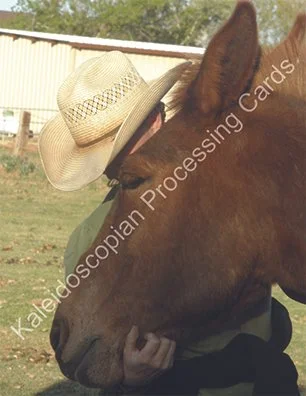
During our time together, Buddy would welcome my company, both coming up to the gate when I arrived and sticking his head over the fence when I left, almost as if to say “don’t go.”  While Buddy and I were growing in our relationship, I wasn’t feeling the same joyful connection with the people.  Suffice it to say that for someone who ran their own horse facility for over twenty years, it was challenging to understand a completely different interpretation of priorities when it came to running an equine establishment.  Because Wendy has been in the big money horse show world for over 35 years, whatever has worked for her is pretty much the way things were going to get done. 

In my journals there is a lot of self-reflection on my passivity.  Notes about how I didn’t want to be “that” boarder who asks to change things.  Because I had also had boarders, one, a friend, who definitely didn’t mind being “that” boarder, I think I was super sensitive to keeping my opinions to myself.  I also struggled with the power dynamic in the people who worked there, not clear who or where to go with my curiosities, questions, and concerns.  I felt like a square peg in a round hole. 

After three months of enjoying the connection between Buddy and I, I looked out into the future realizing I would be in Florida for two and half months, as well as visiting New Mexico frequently.  I determined it would be irresponsible for me to keep Buddy.  He wouldn’t have my companionship for a huge chunk of time and I’d just be writing checks, as well as relying on others to care for him, something I wasn’t confident would end well for Buddy. 

To say that Nancy was pissed at my decision is an understatement.  She was angry because she now had to rehome him again.  She didn’t understand why I couldn’t have anticipated my travel away from Buddy.  I guess I didn’t foresee the downsides that occurred.  I had gone into the relationship only focused on the upsides of having a horse again.  

My Buddy experience offered me a focused, intentional chunk of time spent in a communion with nature, my reflections, and as a seeker.  I was filled with gratitude for the relationship, connection, and physical presence of a beautiful, soulful, soft-eyed horse who in a short time reminded me of the grace and love horses generously offer.

My Buddy journal includes several references to seeing blue herons.  As I’m writing this, a blue heron is in my view just outside my window.  Appropriately,   the blue heron symbolizes patience, self-reliance, and quiet wisdom, representing a calm, independent approach to life's challenges, often seen as a spiritual messenger bridging earthly and divine realms. It signifies transformation, good fortune, and inner strength, embodying the ability to find clarity and navigate complex situations with grace, balance, and purpose.  

Recall a time when you joyfully experienced being in communion with another being or person.  Share some of the specifics of that encounter.

Have you been able to replicate the significant aspects of that joyful exchange in other relationships?  If yes, how?

What are there lessons from the aforementioned stories that you can purposefully integrate into future interactions? 
 

CREATIVITY

CREATIVITY

My Ph.D. program required that I be associated with an organization so that I would incorporate my learning in the “real world”.  When I was accepted into the program, I still did not know what to name the llc. that would serve me in name only until I graduated.  With this question secretly renting space in the back of my mind, one day I was listening to an NPR story while driving down M69 on the way to Lansing.  I recall the woman on the radio referring to a kaleidoscope.  This reference created a mental image of a cylinder-shaped toy with changing images as you turn the tube.  Aha!  A perfect metaphor to represent the work I would offer people.  I intended to create opportunities to turn/change the view of what my clients were looking at, to reframe their image in ways that served their desired outcomes.  Through partnering with horses, we could provide people with a new perspective that invited them to see a situation from a different vantage point.

As I shared in the introduction to this book, I named the company Kaleidoscope for the above reason.  I also didn’t want the company to bear my name.  I’m not completely sure of my aversion to it being called Weber something or something Weber.  Even now as I reflect on the name choice, I physically feel a sort of “ick factor” imagining Weber something as my company moniker. 

This is opposite position I held when I kept my maiden name.  I kept it BECAUSE I didn’t see “Tracy Weber” in “Mrs. William Hausbeck.”  Much to the chagrin of my in-laws.  The decision to stay Weber also confused my parents who were from a traditionalist generation where you did things the way you were expected.  Meaning, a married woman took the man’s name.   

As the first person in our immediate family to earn a college degree, I was living into the independence I experienced at college. I graduated from Michigan State University (MSU) one month prior to our January wedding.  My courses included a thematics in Women’s studies, so I knew that the historical significance of women taking the man’s name was because wives were considered property.  Property.  Let that sink in. 

We were married in 1985, a time when keeping your maiden name was rare.   Bill and I agreed that any children would bear the Hausbeck last name.  He and I even bounced around hyphens, though I decided that was more work than it was worth.  I also knew that I could change my last name at any time.  There is no moratorium on changing one’s name.

So, with a kaleidoscope as a perfect metaphor, how would the company name represent my potential career?   The only thing I knew for certain was equine-assisted services were going to be part of the delivery.  While many people, to this day, do not understand my languaging of “Kaleidoscope Learning Circle, llc.” often calling my business Kaleidoscope Learning Center, the words “Learning Circle” made sense to me.  Calling the llc. a “center” grounded us in just one location and in the beginning I had no way of knowing what the future might hold. 

I definitely wanted the word learning in the title, as learning is where growth happens.  Circle made sense, because it opened the business up to the possibility of creating other “circles”.  I imagined potential circles of influence in a variety of places.  A circle is also a powerful shape in facilitation.  We “circle-up” so that we are all equidistant to each other.  A round, closed circle also represents continuation – no clear beginning or end.

When Kaleidoscope was first created newspapers, radio, magazines, and television advertising were still the primary methods of marketing.  The internet was in its infancy, just emerging as a method of sharing one’s story.  My degree from MSU was in advertising, so I had expertise and enjoyed the creative process of crafting the pages for our website.  I worked with a company near me who could provide technical expertise, optimizing my written words and images.

Ellen, from the tech company, and I decided that the website address should be “myklc” to overcome the barrier of people being able to spell the word Kaleidoscope.  The site featured all the important elements, from “Why Horses” to a “BarnQuest” page with specific directions to the farm.  How to find us was important because at the time MapQuest was fairly new and prone to sending people to the west section of Rathbun Road, instead of the east which is where we were located.  Neither road was actually labeled east or west on the signage, further confusing people trying to find my big blue and white barn.  As is my style, I also included some pretty corny groaner puns throughout the website copy.  Lots of pictures and detailed information about upcoming programs filled multiple dropdowns.

My horse-head logo in a circle also emerged from a creative inspiration.  I was driving on M675 taking the exit onto I-75 when I looked up at a clear star-filled night sky.  In the sky was a bright white full moon.  The moon’s grey shadows created an outline of a horsehead facing right with a pointed ear, flowing mane, and strong neck reaching the bottom of the moon’s cylinder. 

I later discovered that the logo I created looked eerily like the barn logo from where I worked as a kid, JL’s Ranch and Saddlery. My subconscious brought the image to the surface, as even the colors of our two logos were similar.  I did not consciously plan to replicate my childhood farm branding.  Fortunately, JL’s was now PAL Enterprises, so there was no concern about my logo being a duplicate of JL’s.    

When it came time to detail my four-horse trailer, I worked with a local sign maker to make big swooshes reaching from the logo near the gooseneck to the back of the trailer, implying movement.  The multi-colored blue, purplish, and shiny silver magnetic tape changed color as light traveled down the wording and swirls.  Because the sides of the trailer were a beautiful billboard I used to park it on an angle of my parking lot, so that people travelling past the farm could see it clearly.

One of the most creative decisions we made when building the barn was a suggestion by Sara, who helped me design, plan, and create the space that became Kaleidoscope.  The top half of all our stalls were bright blue powder-coated bars. Light and draft size horses appreciate being able to see out of the slated barriers.   Sara suggested we turn the front door on the miniatures stall upside down so that the bars would be on the bottom.  Because Mickey and Minnie were not tall enough to see the over the top half of the door, we flipped the door upside down, giving them a window to the world outside their 10’ x 12’ stall. 

Being “creative” is emotional.  It requires a level of confidence that acknowledges there will be those who do not agree, support, or even understand.  When I’m actively in the process of creating, there is exploration, confusion, and frustration.  My friend, Shannon calls this space, “hell in the hallway”.  Where one door has closed and the other has yet to open.  Staying in the hallway until the door opens is simply part of the journey going forward, getting through the middle to the other side.   

In reflecting on all of the creative decisions mentioned above, the common thread is that when I sense a congruence, an alignment, I can live with whatever choice I am making.  When I land on a place where I can allow for others to understand or not, then the hallway door has opened. 

For me, the birth of creative projects, such as this book, brings with it a soul-fulfilling juice, a lifeforce that lights me up when I get it right.  Creative expression is an embodiment of both my head and heart.  While my favorite place in the world is in partnership with horses or now spending time with my grandson, tapping into creative energy and channeling an emerging future is right up there on the list of what makes life worth living!      

Recall a time when your creative approach led to the result you desired.

How do you physically feel when you’re being creative?  Describe the sensations in your body.

What can you do to commit to more creativity in your life? 

POTENTIAL

POTENTIAL2

When Randy asked me to marry him in 2012 my Large Munsterländer (a German pheasant dog), Desi, was already twelve years old.  Her half-sister, Cirena, was filled with cancer at the age of twelve, so I imagined that in the two years before our wedding in 2014 that Dez would travel a similar life path.  Once she passed, I would be at a cross-roads with the farm, figuring out what to do with the remaining live animals and the property.  Until that time, I planned to continue as I had, taking care of the property, offering limited programming, and staying active in the community.  Oh, yea, and planning a wedding!    

I couldn’t sell the property as long as Desi was living because she couldn’t move with me to my husband’s home.  First of all, it wouldn’t be fair to her. She was already losing her vision and hearing, was weak in her hips, and had accidents in the house.  Additionally, she shed.  A lot.  Between her and my daughter’s French Brittney, Kahlua, we’d often have bundles of rolling black, white, and brown dog hair in the kitchen!

When Randy and I got married in October 2014 my “Blessed Purgatory” began.  I was blessed because I had the assets to keep the farm.  The purgatory was that I was stuck in a limbo of my own making.  Paying and caring for a farm/business that I wasn’t growing.  I akin it the COVID lock-down, where there was not a definitive end in sight.     

Recognizing that eventually Desi would cross the rainbow bridge, I began the arduous task of cleaning out twenty years of living in the same place.  One-by-one I cracked open each book from my many bookshelves, deciding whether I would ever open it again.  Because I take notes in my books, a hundred or so made the move to town with me, while a similar number didn’t make the cut.  Instead they were put in boxes for donation to the local library.

I lived through all the stages of grief (denial, anger, bargaining, depression, and acceptance) with each new box of folders from my Kaleidoscopian file cabinets.  Reliving over twenty years of successful programs and failed efforts was emotionally draining.  I jokingly call myself an “archivist” instead of a “hoarder”, the truth being somewhere in-between.  

In between moving into my now husband’s home in Frankenmuth literally one Jeep load at a time, I sought ways to channel my creative energy.  I searched for something to offset the draining emotional bandwidth of reliving the past.  Something with potential to bring my values to life. Ever a lover of learning and research, I embarked on a quest to identify what else I could do with my property.  I hired a very talented creative local guy named James.  James is a kind soul who respected this crazy lady’s dream of creating something so unique that we couldn’t find a duplicate of anywhere in the world.  He supported me in crafting language, identifying target markets, with appropriate, measurable goals, and creating a beautiful logo I wish I could use someday.  This thought activity was very expensive in terms of both time and money. It was also expensive in terms of social capital, as I shared the story far and wide, to garner support and learn about people’s reactions. 

Here's some of the copy I wrote:

Kaleidoscope Ranch is an enriching environment for both the animals that live here and the visitors that wish they did! Experience our living farm museum environment inviting you and your family to engage with nature, exploring the culture and historical period from 1865-1895.   The “Old West” of saloons, honkey tonks, and a trading post meets Michigan’s lumbering era as you travel from the outside to the inside of our barn.  Our themed and enriched horse, goat, rabbit, chicken and duck homes are central to a Kaleidoscope Ranch experience.

Our mission:  Kaleidoscope Ranch is a place to visit, explore, and enjoy. We help families and visitors reconnect with the wisdom of animals and agriculture through fun moments of learning. Just like the kaleidoscope in our name, we strive to make each visit to our ranch a unique combination of beauty, energy, and reflection

At Kaleidoscope Ranch, we uniquely blend the world of animals and humans, leveraging the best of both for the brief time you are together.  See the world through the eyes of our critters, where there is no religion, no class or management system only the way you are in relationship with them in that moment.  We are experts in creating experiences, events, programs, and activities that invite you to be fully present in the moment, having fun, learning something relevant about yourself and others, and providing a memorial, sometimes life-changing, new awareness.

I dreamt up all sorts of unique experiences, packages, events, and gatherings.  My lifetime of event planning and party throwing was packed into the 12.27 acres on Rathbun Road. One of the most unique aspects Randy and I researched was purchasing a railroad car.  A near-by town used to have an attraction called Junction Valley Railroad.  As an homage to my Dad whose work on the railroad put me through college and so much more, I imagined a railcar on property.  Unfortunately (or fortunately as it turned out) we were unable to secure one. 

I planned to offer events such as “Feed the Soul and the Bellies Breakfast”.  The gist of this offering was to invite families to help feed all the critters, followed by a shared gourmet breakfast that was partially prepared by my guests.  I imagined strangers becoming friends over family-style meals. 

My tree-line of pine trees would be cleared to create “PoeTrees” where visitors could discover laminated weather-proof poems, selected by my friend, Faith, inviting people to appreciate nature.  We’d scatter them through the trees, creating a sanctuary with benches, fairies, and other woodland creatures.

Kaleidoscope Ranch was purposefully designed to be experienced with or without a guide.  For a guided tour, which includes silly jokes, hands-one experience with the animals of your choice (we reserved the right to deny access to certain animals based on the circumstances), and a snack at the end of the tour.  Why stop at just an experiential nature-based amusement family destination?  Nope.  This girl added “taking it on the road” as an option. 

This thought experiment included detailed information on a potential website with a FAQ, group sales, memberships, planning your visit, volunteers AND (of course!) required volunteer training.  I was so detailed that I included facts about responding to a volunteer request within three days.  I even met with a friend, former classmate, Mike, whose business is to create signage in American braille.  I went so far as to become a member of the Michigan Agritourism.  My listing optimistically shouted “coming soon”. 

Yup.  I poured my heart and soul into this.  As I reflect on that commitment (overcommitment?) I would assess that my behavior was a coping mechanism.  Always a dreamer, creator, believer in possible futures, this investment kept me “in” something and probably “out” of some trouble.  One piece of advice I share with people in transition is to not just go away from a thing (such as a job or a relationship), that it is healthier to have/create a thing to go towards. 

Those who love me, Randy, my accountant, friends, appreciated my enthusiasm and supported the dream – the potential.  Those who never understood (and probably still don’t) the “horse thing” I’m sure had a different story.  Probably thought I was out of my freakin’ mind! 

I ultimately decided that Kaleidoscope Ranch had more risk than potential when I looked at the venture from a perspective that showed me the bigger picture.  It was as if I had finally turned a kaleidoscope, the bits and pieces falling into place, creating the view that showed me the totality of the investment this unproven endeavor would require of me – lots of money, huge staffing requirements, animal husbandry, and so much more!

Once you know something, you can’t unknow it unless you are in denial.  So, knowing what I did, I now faced the inner work of pride to explore a dream versus the shame of not following through.  As I write this nearly a decade later, I still see the potential the Ranch could have offered people for real connection with each other, their loved ones, and nature.  Something the world craves now more than ever!

I started living part-time at Randy’s while Desi was still alive after hiring Happy K’9’s to watch her when we wintered in Florida for the months of January through March.  With Nick from Happy K’9’s taking care of her three times daily, not actually living with her, I experientially discovered she would be okay without me there every night.

Desi finally took her last breath on October 14, 2018 at the ripe old age of 18 years, 10 months, and 14 days.  She left this world unable to stand, see, or hear.  She was able to try to bite our vet, Glen, as he gave her the shot that ended her life.  Desi wasn’t about to let someone limit her potential if she could help it!      

Recall a time when you saw the potential in an idea.  What actions did you take to pursue it?  What did you learn along the way?

Reflecting on the time above, can you name how you’ve incorporated those learnings into your life today?

Is there something in the future that you’d like to explore further that has potential?  What is it and what are your next steps?    

PRESENCE

PRESENCE

I met Stacie Johnson through the horse trainer, Robin, at Whispering Pines Farm where I planned to board a new horse.  At 40 years old I was looking for a rideable pleasure horse.  I knew Morgans from my past years showing as a kid, though was open to other similar breeds such a Quarter Horse or Arabian.  Stacie is an Arab girl, specifically, Egyptian Arabians, having bred and raised them for most of her adult life.  So naturally, she found a healthy, middle-aged, Egyptian Arab gelding; a former endurance horse that the owner was looking to sell. 

Stacie and I drove together to the owner’s house excitedly learning more about each other, exploring our shared interest in partnering with horses to help human development.  Stacie is a licensed mental health professional who provides therapy for people through a typical office practice.  She’d worked with a variety of populations, though never heard about equine-assisted services.  She almost couldn’t believe that there was a modality that combined her two passions, helping people AND partnering with horses! 

 I was introduced to equine-assisted learning (EAL) during my Ph.D. program.  The doctorate I earned was based on creating an individual development plan, which allowed participants the opportunity to attend conferences, workshops, etc., then create courses from those experiences.  Because of this learner-centered approach, I attended an equine-assisted retreat and one large conference. Now that I completed my degree it was time to start offering opportunities for other people to experience EAL with me facilitating.  Stacie agreed to be my equine-specialist/co-facilitator in this new endeavor.      

 As I turned into the bumpy dirt driveway, we could see two brown mid-sized horses, grazing in the pasture behind an old two-story farmhouse.  The owner was a typical rural neighborhood horse owner, jeans, boots, cowboy hat and an attitude that implied he knew everything about horses.  He and Stace were acquaintances, which is how she knew about Al. When we arrived at his farm, I didn’t pay much attention to the human exchanges; it was all about the horse for me. 

 I hadn’t been around horses in over ten years and was feeling scared, unsure of myself as a horseperson.  Thankfully, Stacie was encouraging, and I trusted her advice, even though we were just beginning our life-long friendship. We all walked into the back pasture where Al and the other horse, a mare, were loose in the field.  When we approached Al, the mare pinned her ears flat back and began to “run block” putting herself between the humans (the owner, Stacie, and me) and her gelding friend, Al.  I didn’t recognize the mares’ behavior as significant at the time because I was too in my own head about whether or not Al was the horse for me.

 Looking back, I now know that there was an opportunity here to facilitate an EAL experience.  You see, EAL sessions can happen organically, simply by bringing horses and humans together in shared space.  In its’ broadest sense, an EAL experience is when you facilitate or explore, the beliefs, theories, and assumptions between both the horses’ behavior and the humans’ choices. 

 Stacie and I weren’t yet trained in the EAL learning modality.  I’d been exposed to EAL through a couple of conferences.  The journey into all things equine-assisted was just beginning.  In the next twenty-five years, I would go from attending conferences, to presenting at them, to providing training programs, to becoming EAL faculty, to integrating EAL into non-equine college courses, to winning several awards for my work. 

Stacie and the owner responded to the mares’ interfering by haltering her, removing her from our interaction with Al.   The mare being able to push Al around meant he was lower in the hierarchy than she was.  This fact could be relevant if I was adding a new horse to an existing herd.  If you’ve got a herd with a dominant lead mare, one who has a strong sense of their leadership, then there typically is not a problem adding a lower-level herd member.  If your situation includes bullies higher up the ladder, then it’s possible the lower-level herd member will become ill, hurt, or wither because of the rejection.  Horses and humans are similar in our social contracts.  We depend on others in our community, basing our relationships partially on mutual respect, as well as effective and clear communication.

 The owner stood holding the haltered mare, then asked me if I wanted to ride.  Many horse owners love to ride.  Even as a kid, nationally showing Morgans, riding was a means to an end for me, not something I did purely for fun.  I rarely fell off, though never felt as though I achieved a natural “seat”.  I practiced enough over the years from age twelve to seventeen to be a decent rider, winning one contest out of many, the Mid-Atlantic Morgan Horse Show in Pennsylvania.    

Stacie, sensing my fear, offered to ride Al first.  After the owner threw on a western saddle and snaffle bit bridle, he announced that we could “take him for a spin.”  Stacie easily swung her leg up over his back, settled into the seat, and walked him off.  She asked him to trot by squeezing her legs, moving him into a faster gate.  They trotted around the pasture a bit, then came back to where I was standing watching. 

Now it was my turn to ride.  I nervously gathered the reins at his neck, then swung my leg over the saddle.  I relaxed into the saddle, asking him to walk by applying a little pressure with my legs.  Al moved forward slowly.  I took a deep breath, looked around, flooded by memories of the hundreds of hours I spent in a saddle in my youth.  Muscle memory is a funny thing.  My fear diminished as I eased into the rocking sensation of Al’s footsteps on the hard earth.

I pulled back gently on the reins, asking him to stop, adding a “whoa” for good measure.  Al stopped, letting me dismount, boot-clad feet landing firmly on the ground.       

Reflecting on my first introduction to Al, one thing I remember most is looking into Al’s eyes and making a heartfelt connection.  His gaze seemed to be an appeal.  It was as though he was asking me to remove him from his current situation. Between his look and his name, the decision to buy Al was easy. Why was I so enamored with a horse named The Alkkhmist.  Alchemy is “a power or process that changes or transforms something in a mysterious or impressive way”. 

 The mission of Kaleidoscope was/is to partner with equines to help people transform into the best version of themself.  Starting the business with Al seemed as though our collaboration was destiny; a sign that Kaleidoscope had an optimistic future.  Launching a business is scary, especially when you’ve never done it, nor has anyone in your family.  Believing in messages from a higher power has guided me throughout my life, and finding The Alkkhmist sure seemed like a good sign! 

 Al, was, and still is, a companion.  There is a picture of him in every room in my office!  While he is no longer on this earthly plane, his spirit guides me and continues to help me transform.  He was aptly named The Alkkhmist, forever representing an invisible magical force in my life and work.

Have you had an experience where something magical or unexpected happened.  What are your beliefs about being present in that experience?

Do you have practices, habits, or rituals that you embrace to invite more presence?  What are they and how do they make you feel?

Is there something missing in your practice that you’d like to change or invite into future experiences?  What actions are you going to take to create more presence in your life?


PERSONAL POWER

PERSONAL POWER

In 2005 Rochester Institute of Technology (RIT) accepted my proposal to offer an equine-assisted learning (EAL) session for their Pluralism Conference.  RIT is where I earned a master’s degree and was a faculty member for several years.  Our proposal was accepted because we explained that horses respond to a person as they show up in relationship with them.  They frankly don’t care if you have money, status, or a title such as CEO, President, or the biggada boss.  Understanding that difference is our only opportunity for learning (Michael Broom) invites infinite possibilities and curiosity.  We, then, have agency and can offer the same to others, seeking to leverage the positive for mutually beneficial outcomes. 

We, my equine specialist and friend, Sara and I, secured a barn and horses near the RIT main campus.  A group of eight students from RIT’s National Technical Institute for the Deaf, their interpreter, and a RIT faculty member chose to spend the afternoon with us.  We began the EAL experience in our standard way with “meet and greet” experiential activities for both horses and humans.  Creating connection before content is a core value of Kaleidoscope’s programming. 

We were in an indoor horse arena with a large open area where horses were walking, sniffing the ground, and settling into the space together.  The humans are nearby, separated from the horses by a corral.  The humans are invited to enter the horse’s space and greet each one however they feel comfortable.  A greeting can be from a distance, just making eye contact, or close, including friendly scratches for the horses. Not only is the approach decided by each individual, we also do not prescribe anything about the exchanges, such as how long, only one person per horse at a time, etc.   Our lack of specific direction allows us, as facilitators, to witness the choices made by the participants.  Do they pay attention to how their actions impact others’ experiences?  How do the horses respond – do they move away or toward anyone?  What is the energy of the experience – is it heightened and frantic or calm and peaceful?      

The second activity we invited participants to experience was “catch and halter”.  The sequence of meet and greet – just being in a shared space for horses and humans - to asking something of each other, haltering, moves both beings from strangers into building relationships.  One of our jobs as facilitators is to create a place where humans, who may be unfamiliar with hanging out with 1,200-pound hooved animals, get more comfortable.  There’s a sweet spot creating engaged learning environments, which is just outside the comfort zone in the learning edge.  Not everyone’s “edge” is the same, so there is some mastery in managing this space for all the participants. 

For catch and halter, the participants were invited to halter the horses.  A halter is designed to go over the horses’ ears, with the horses’ nose in the center and a snap or tie under the throat.  Again, the participants were not given any specific instructions, nor were they shown the “correct” method of putting on a halter.  We designed this activity to support a learning philosophy of “no right or wrong, just different”.  And the students did not disappoint!  Halters were put on upside down, lead ropes were clipped to the sides of the halter, instead of the bottom; truly many creative alternatives to the standard way of haltering a horse!  Thankfully, our four-legged facilitators stood calmly and allowed for all sorts of learning to safely take place. 

An additional element to the activity is we invited the participants to take part in haltering without talking.  If they talked then they would have a consequence of their choosing.  Because this was the first time we worked with a deaf population, we engaged in an open conversation about what “talking” meant.  It was mutually decided that our rule meant no verbal communication or sign language would be allowed without a consequence.

Nonverbal communication is critical to all animals. While many humans may think they are primarily responding to verbal communication, significant research has shown that we instinctually and unconsciously read and react to nonverbal signals in greater proportion than the spoken word. Horses and other animals are masters at reading subtle changes in body language and other nonverbal cues. For example, a horse’s ears tell you many things about their mood, where their attention is, and in combination with their eyes they can be very expressive and interpretive.  Learning to understand the subtle cues of the equine language requires focus in a way that can help people really “see what they are looking at,” inviting one to stay in the present moment.  

One of the most interesting take-aways from this session was that the individual most challenged by our “no talking rule” was the student’s interpreter.  She shared how she struggled with not being able to fulfill her role as a communicator for the students.  Was this because more of her identity and sense of self was tied to the limitation or rule imposed? 

How often do we inadvertently put ourselves in a similar situation to what the interpreter was feeling?  Meaning, where do we experience limiting beliefs that get in our way of moving forward and threaten our sense of self?  One of the reasons that EAL can be so powerful to human development is because we create a safe place to practice challenges, barriers, and constraints such as imposing a no talking rule.   We then debrief, allowing for reflection and insight into alternative choices.  This opportunity is important because, “We see the world not as it is, rather we see it as we are” (Anaïs Nin).     

Each of us has abilities and disabilities, some visible and most invisible.  These aspects of who we “are” constantly changes, evolves, and informs our actions both consciously and unconsciously.  This is why the adage, that “actions speak louder than words” holds true.  The more self-aware we become the better the chances are that we will make decisions that are congruent with our intentions. 

Where does our personal power have the most impact?  Eistein offers us insight… A human being is a part of the whole that we call the universe, a part limited in time and space. He experiences himself, his thoughts and feelings, as something separated from the rest--a kind of optical illusion of his consciousness. This illusion is a prison for us, restricting us to our personal desires and to affection for only the few people nearest us. Our task must be to free ourselves from this prison by widening our circle of compassion to embrace all living beings and all of nature. ~ Albert Einstein

 Recall a time when the story you told yourself reduced or eliminated your personal power.  What happened? What helped you recognize that you had abdicated your power?

Do you have practices or rituals that help support your in maintaining your power?

Is there a situation you anticipate in the future where you are at risk of allowing your power to be diminished?  What can you do proactively to maintain your power? 

CONGRUENCE

CONGRUENCE

Spread out across the pasture are two miniature horses, one draft, and three “light” horses.  All have their heads down munching on the still-green grass.  The sky overhead is blue with puffy white clouds.  A gentle breeze adds a little chill to this nearly perfect mild fall Michigan afternoon.

Paul was facilitating this activity for the Equine-Assisted Education (EAL) Symposium at my farm.  The three-day gathering brought together EAL providers from around the country who shared a love of partnering with horses in educational settings.  Among the participants were both people new to the field and several who helped create it.  We welcomed Debbie from Indiana who was a founder of programs supporting youth development of life skills.  Also, in the crowd was Ed who worked for a college, offering EAL programs as part of a human resources course.  There were also students in Prescott Colleges Master’s from equine-assisted learning and mental health, from throughout the US and Canada. 

The symposium was divided into chunks, led by some of the most experienced EAL providers in the country.  Paul and Pam were leading the activity that brought us out into this open pasture.  Paul began explaining, in his gentle cowboy way, that he invites the group to divide themselves into pairs, with each pair matching up with one of the horses currently ignoring us.  The goal of the activity is to halter the horse, then let the horse keep doing whatever it wants to.  The humans’ job is to keep the lead rope loose, seeking to match the energy, steps, and cadence of their equine partners.  Paul finished the instructions, then showed the group a pile of halters to choose from. 

One by one participants paired up, finding partners, then selecting a halter.  The halter selection determined the horse the pair was going to work with because of its size.  Mini halter.  Mini horse.  Huge halter.  Huge horse – our draft Tigger.  Mid-size halter – Al, Diva, or Charlie Brown.  With halters in hands, the pairs slowly walked toward their chosen horses, scattered across the three-acre field.   

Charlie decided he’d rather not be haltered because that usually represents work, so he slowly trotted a few steps, then stopped dropped his head and returned to munching on the grass.  The pair of determined participants approached him.  He sensed the pressure of the people, trotted a few more steps, putting distance between the halter and himself.  The pair decided to take a new approach.  One person, without the halter, arcs around to the front of Mr. Brown and began scratching the side of his neck.  Distracted by this friendly gesture, the second person was able to slowly saddle up next to him, slipping the lead rope over his neck.  Knowing he’s caught, he sighed deeply in resignation.  The participant removed the lead rope from his neck, gently putting his nose through the halter opening, flipping the strap behind his ears, snapping the clip shut.

Looking out across the pasture, a sea of pairs of humans with their horse partners.  Most are standing next to their haltered horse waiting for the horse to move.  Others appear to be concentrating on matching their movement, step by step with their horse, seeking to coordinate their speed, tempo, and pace to match their horse’s movement.  To mirror the movements, the humans must be fully present with their horse, ignoring their human partner as well as the rest of their surroundings.  Some are concentrating so hard, one might consider them in a flow state.

People experiencing a flow state have intense focus; their attention is completely directed towards the task at hand, with minimal distractions. They also lose their self-consciousness, no longer worrying about failure or what others might think, wholly absorbed in the activity. Time seems to pass quickly, with the activity itself intrinsically rewarding, rather than seeking external validation or goals. Lastly, there is a feeling of effortlessness. The activity feels unforced and natural, even if it's challenging.  Flow state, also known as "being in the zone," is a mental state where a person is fully immersed in an activity, with intense focus and enjoyment. 

After 30 minutes or so, Paul and Pam shout out for the group to huddle up in a circle to share what they’ve experienced.  Each pair removes the halter from their horses, who all wander away slowly, continuing to graze. 

Pam begins by asking the group, “What struck you?”

Morrigan speaks up first, “being in sync, anticipating what Mickey was going to do next was harder than I expected.  As a lifelong horse owner and rider, I expected to easily match up with him.  Instead, I found myself trying to catch up, not really matching his movements step for step”. 

Pam then asked her, “what do you image made the task so difficult?”

Morrigan replied, “I’m guessing it’s because of my expertise got in the way of my being able to stay present and curious.  Wow, I wonder where else I’m just looking for what I expect to happen, not open to other possibilities?”

Next Jayna jumped into the conversation.  “Mo, I remember a time during one of our Prescott intensives at Chauncey Ranch where a similar experience happened to me.  The assignment was to pick up all four hooves, one at a time.  Now, I’ve picked up horse feet 1,000 times or more she laughed.  So, when I moved into position with my back towards the horse’s head, bent over, and ran my hand down the mares’ leg, gently asking the horse to lift its’ foot I fully expected that she would respond to my cue and lift her leg.  This time nothing happened.  Her hoof stayed firmly planted on the ground, glued to the dirt.  Laura was facilitating the activity, she suggested I re-group by taking a deep breath, get present and try again.  I followed her advice.  The second try the horse understood my ask, easily lifted its’ hoof as if pulled up by a rope.

“Thank You Morrigan and Jayna for your willingness to be vulnerable with this group, sharing those examples.”  Stated Pam.

“One way to reflect on this experience is to recognize the difference between “doing” and “being” she continued.  “Sometimes doing is all that is required of us in order to meet the goal and/or achieve success.  Other times, we are being asked to be more fully present.  Laura’s suggestion to Jayna, to take a deep breath, re-centered her, inviting Jayna to be instead of just do.  See what I mean?” she inquired.  

All the participants nodded their heads affirmatively.  Pam then closed the activity by inviting the group to spend our remaining day and a half practicing being in sync with each other.  Giggling, participants organically paired up again matching their steps with each walking back to the barn as if their legs were tied together in an old-fashioned sack race.  Once again, our horse partners extended a simple invitation to be more fully present!                                   

Recall a time when you performed a task poorly because you mismatched your expectation of how simple the task would be?

How have you taken the lessons from that experience and applied them to other situations?

Is there an event or experience in your future where aligning your intentions and actions could have a significant impact? 

What  can you invite into your life to support the results you desire?